


Emerging markets have helped broaden equity leadership in 2026, but that does not automatically mean they are delivering true diversification. For investors, that distinction matters.
Presented by: Bruce Hosler
Equity market leadership may be broadening, but the underlying theme is not
Emerging markets have helped broaden equity leadership in 2026, but that does not automatically mean they are delivering true diversification. For investors, that distinction matters. EM has been a bright spot this year and may look like a natural way to expand beyond U.S. equities, but much of that strength is still tied to the same AI-related drivers that have powered developed markets. In other words, leadership may be broadening, while the underlying theme remains more familiar than many investors realize.
Under the hood
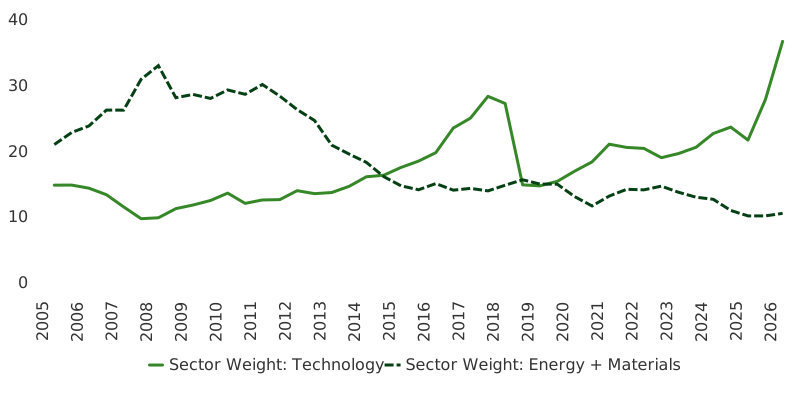
There are clear reasons why EM has worked this year. Returns have been strong, valuations remain more reasonable than in the U.S., and the index looks very different than it did in earlier cycles that were more tied to commodities (Exhibit 1). Through May 26, 2026, the MSCI EM Index was up about 23.3% year to date, ahead of the NASDAQ Composite at 15%, S&P 500 at 10.3%. and MSCI EAFE at 9.3%.1
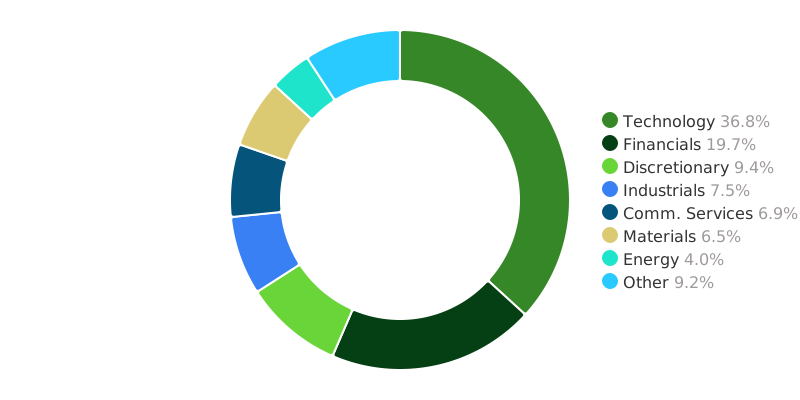
Exhibit 1: The composition of the MSCI EM Index has shifted dramatically over the years from a heavy weighting in energy and materials to technology.
Source: FactSet, as of 4/30/26. Past performance is no guarantee of future results.
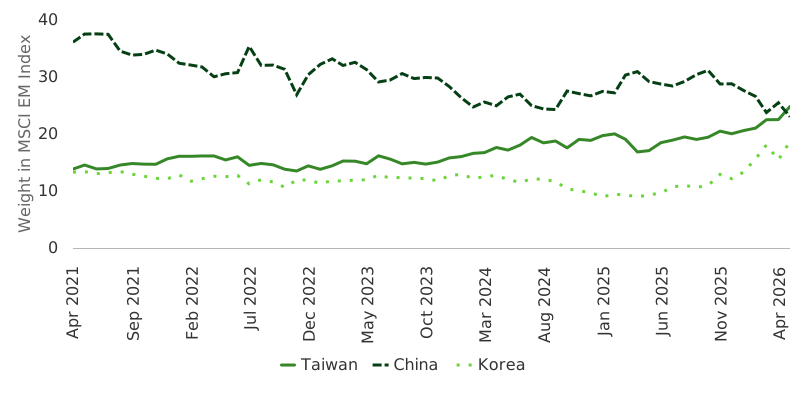
Exhibit 2: Taiwan has overtaken China as the biggest market in the MSCI EM Index, and both Taiwan and South Korea are highly concentrated in just a few names.
Weight in MSCI Emerging Markets Index
Highly concentrated indices, index weight of largest stocks
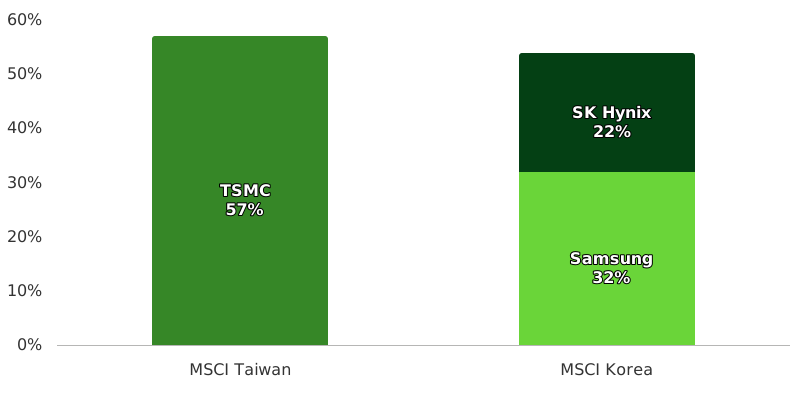
Source: FactSet, Morningstar Direct. Taiwan Semiconductor Manufacturing Company (TSMC), SK Hynix, and Samsung represent the largest weightings of the MSCI Taiwan Index and MSCI Korea Index, respectively. Data as of 4/30/26.
A deeper look at country and sector weightings across EM illustrates the significant focus on AI. Technology now makes up nearly 37% of the MSCI EM Index, as seen in Exhibit 1, and the largest country weights remain concentrated in markets closely linked to AI and semiconductor demand, including Taiwan, China, and South Korea (Exhibit 2). Three companies, TSMC, Samsung, and SK Hynix, are the biggest stock weights in the MSCI Taiwan Index and MSCI Korea Index, respectively, and contributed nearly 21% of the MSCI EM Index’s 23.5% year-to-date through May 26. TSMC is playing a fundamental role in the AI hardware ecosystem, while South Korea-based Samsung and SK Hynix together control about two-thirds of the high-bandwidth chips market used by AI servers.
For investors, the key point is that EM may offer a lower-cost way to access some of today’s strongest growth themes, but it may not provide as much diversification from those themes as they might expect.
Portfolio takeaway
The more important portfolio question is not simply whether EM looks attractive, but what role it is meant to play in a portfolio. EM still trades at a valuation discount, which can make it appealing, but much of that exposure remains connected to the AI build-out rather than offering a distinct source of return. For clients seeking genuine diversification, developed international equities and U.S. large-cap value may offer a more differentiated complement to growth-heavy U.S. portfolios. Said differently, EM can still have a place in portfolios, but investors may want to frame it as selective participation in global growth and the AI trade rather than as a pure diversification trade.
Why it matters for investors
In a market where investors are looking for broader leadership, the opportunity is not just to add exposure, but to be more intentional about what kind of diversification they are actually getting.
1. Source: FactSet.
Index definitions:
MSCI Emerging Markets Index is a market-cap-weighted index that includes large and mid cap companies in 27 emerging-markets countries.
MSCI EAFE Index is a market cap-weighted index that includes large/mid cap firms in 21 developed-markets countries, excluding the U.S. and Canada.
The MSCI Taiwan Index is designed to measure the performance of the large and mid cap segments of the Taiwan market. The index covers approximately 85% of the free float-adjusted market capitalization in Taiwan.
The MSCI Korea Index is designed to measure the performance of the large and mid cap segments of the South Korean market. The index covers about 85% of the Korean equity universe.
S&P 500 index is a market capitalization-weighted index of 500 common stocks chosen for market size, liquidity, and industry group representation to represent U.S. equity performance.
Nasdaq Composite Index is a market capitalization–weighted index that is designed to represent the performance of NASDAQ stocks.
DISCLOSURES
Views expressed are as of the date indicated, based on the information available at that time, and may change based on market and other conditions. Unless otherwise noted, the opinions provided are those of the authors and not necessarily those of Fidelity Investments or its affiliates. Fidelity does not assume any duty to update any of the information.
Investment decisions should be based on an individual’s own goals, time horizon, and tolerance for risk.
These materials are provided for informational purposes only and should not be used or construed as a recommendation of any security, sector, or investment strategy.
Stock markets, especially foreign markets, are volatile and can decline significantly in response to adverse issuer, political, regulatory, market, or economic developments.
Foreign securities are subject to interest rate, currency exchange rate, economic, and political risks, all of which are magnified in emerging markets.