




How Stablecoins Are Quietly Reshaping the Future of Money

Share:


Table of Contents
Understanding the Shift from Traditional Finance to Digital Dollars
For decades, transferring money meant dealing with delays, fees, and friction. Whether wiring funds across borders or writing a simple check, every transaction required multiple intermediaries — and time.
But that system is changing rapidly. With the rise of stablecoins, we’re witnessing a turning point in how people send, receive, and manage money — faster, safer, and with greater independence. At Hosler Wealth Management, we believe understanding this change isn’t optional; it’s essential for anyone who wants to stay financially informed in a digital economy.
What Are Stablecoins?
Stablecoins are digital currencies designed to maintain a consistent value, typically pegged to the U.S. dollar. According to a Brookings Institution analysis, “They (Stablecoins) are digital, cryptographic tokens whose values are pegged to those of other assets, like the U.S. dollar.”
Unlike Bitcoin or Ethereum, whose prices fluctuate daily, stablecoins are built for stability and practical use.
They’re the bridge between traditional finance and blockchain innovation — offering the convenience of cryptocurrency without the volatility that once made digital assets feel risky.
For a foundational walkthrough, listen to our earlier episode What Are Stablecoins? which discusses their origins.
The Problem: Friction in the Current Financial System
Every time you swipe a credit card or wire money, you pay for the system’s inefficiency:
Credit card fees can reach 3% per transaction.
Wire transfers often take days to clear.
Paper checks still rely on manual processing between banks.
Each step represents friction — wasted time, effort, and cost. Stablecoins eliminate that friction by operating on blockchain technology, where transactions are verified instantly across a transparent, decentralized network.
How Stablecoins Eliminate the Middleman
Imagine buying a home, paying a contractor, or sending money abroad — all in seconds.
With stablecoins, you can transfer verified funds directly to another party without banks or wire services. The blockchain records and secures the transaction in real time.
This isn’t hypothetical — it’s already happening. Institutional adoption is under way. “JPM Coin already processes about $1B in daily transfers for wholesale clients.” Bloomberg
Addressing Common Misconceptions
One common concern we hear at Hosler Wealth Management involves confusion between stablecoins and Central Bank Digital Currencies (CBDCs). When lined up next to each other, they’re fundamentally different:
| Feature | Stablecoins | CBDCs |
|---|---|---|
| Issued by | Private entities (regulated under U.S. law) | Central or national government |
| Purpose | Efficiency and freedom of use | Government-backed control and oversight |
| Privacy | Maintained through blockchain decentralization | Subject to government monitoring |
Stablecoins aren’t about giving control to government systems — they’re about empowering individuals with faster, more transparent access to money.
The Next Frontier: AI Agents and Financial Automation
Now, layer in Artificial Intelligence (AI) and you have the makings of a financial revolution.
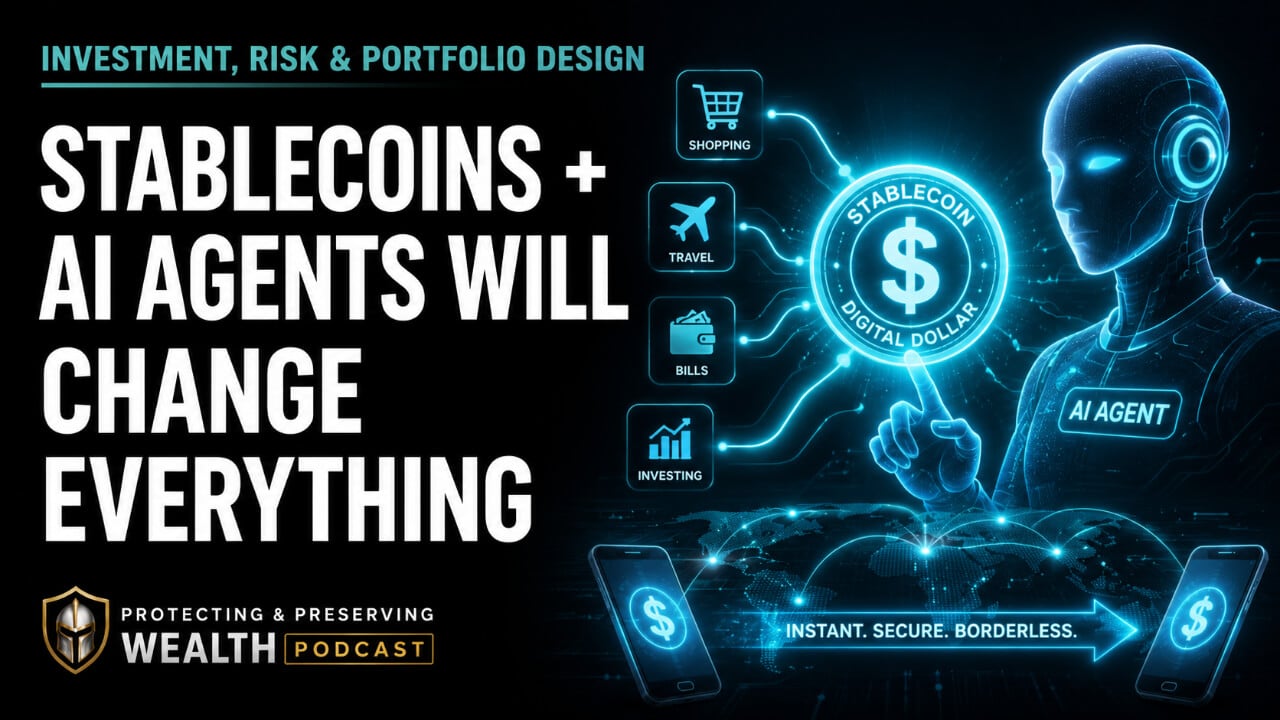
Picture this: an AI assistant that books your flights, pays your recurring bills, and manages your digital wallet — all without sharing your personal information. With AI agents using stablecoins, every transaction can happen securely and autonomously.
Need to pay a bill while traveling? Your AI agent can handle it instantly.
Want to buy an item once it drops to a target price? Your AI agent can execute the purchase automatically.
Managing recurring expenses? Your AI agent can pay them on schedule — no late fees, no stress.
This isn’t science fiction. It’s the next stage of financial convenience, and it’s closer than most realize.
Why This Matters for Investors and Retirees
Stablecoins will likely become a central part of how we save, spend, and invest in the next decade. For retirees, automation through AI and stablecoins could simplify financial management while maintaining control and transparency.
Imagine a world where your AI assistant:
Automatically pays your monthly bills from a secure account
Ensures travel expenses are covered without sharing sensitive data
Provides instant, auditable records of every transaction
It’s not about replacing financial advisors — it’s about empowering them and their clients to work more efficiently and securely.
The Human Side of Technology
Technological change often sparks fear — especially around privacy, security, or job loss. But as our hosts discussed, it’s not about replacing people; it’s about replacing inefficiency.
The future belongs to those who adapt and harness these tools responsibly. At Hosler Wealth Management, we believe embracing innovation — guided by prudence and understanding — can lead to greater financial resilience.
Preparing for the Shift
This evolution in money and technology isn’t decades away — it’s happening now.
To prepare:
Learn how blockchain and stablecoins work.
Talk to your financial advisor about how digital assets may fit into your long-term strategy.
Stay informed — technology will keep advancing, but knowledge is your best protection.
Final Thoughts
The future of finance won’t be defined by fear of technology but by how wisely we use it. Stablecoins represent a step toward faster, more secure, and transparent transactions — a world where money moves as quickly as ideas.
At Hosler Wealth Management, our mission is to help clients navigate this changing landscape with confidence and clarity. Because protecting and preserving your wealth means understanding not only where your money is — but where it’s going next.
References-
1. Brookings Institution. “What Are Stablecoins and How Are They Regulated?” (2024).
2. Bloomberg. “JPM Coin Now Handles $1 Billion in Daily Transactions.” (Oct 26, 2023).
For more information about anything related to your finances, contact Bruce Hosler and the team at Hosler Wealth Management. https://www.hoslerwm.com/contact-us/
Call the Prescott office at (928) 778-7666 or our Scottsdale office at (480) 994-7342.
To view all Protecting and Preserving Wealth Podcast episodes: https://www.hoslerwm.com/protectingwealthpodcast/
Limitation of Liability Disclosures: https://www.hoslerwm.com/disclosures/
Copyright © 2026 Hosler Wealth Management, All Rights Reserved. #ProtectingWealthPodcast #ProtectingandPreservingWealthPodcast #HoslerWealthManagement #BruceHosler
Produced by JAG Podcast Productions – www.jagpodcastproductions.com.
Host


2018-2025 Forbes Best In State Wealth Advisors, created by SHOOK Research. Presented in April 2025 based on data gathered from June 2023 to June 2024. Not indicative of advisor’s future performance. Your experience may vary. For more information please visit.
Guest Profiles

Jason Hosler holds Series 7 and 66 FINRA securities registrations. He brings a technological edge to our firm and helps many of our clients stay current in the fast-moving age of the internet.

Bruce Hosler, Jason Hosler, and Alex Koury were collectively recognized as 2025 Forbes Best-In-State Wealth Management Teams, reflecting their collaborative approach to comprehensive wealth, retirement, and advanced tax planning. This recognition is a fantastic milestone for us, and it inspires us to continue delivering outstanding service to our valued clients every day.
2025 Forbes Best-In-State Wealth Management Teams, created by SHOOK Research. Presented in Jan 2025 based on data as of March 2024. 11,674 Management Teams were considered, approximately 5,300 teams were recognized. Not indicative of advisor’s future performance. Your experience may vary. For more information, please visit.
Transcript
How Stablecoins Will Change Everything
Speakers: Bruce Hosler, Jason Hosler & Jon Gay
[Music Playing]
Jon Gay (00:05):
Welcome back to Protecting and Preserving Wealth, I’m Jon Jag Gay. I’m joined by Bruce Hosler and Jason Hosler of Hosler Wealth Management. Welcome, gentlemen.
Bruce Hosler (00:12):
Thank you, Jon, welcome.
Jason Hosler (00:13):
Good to see you.
Jon Gay (00:14):
So, we are going to get into part two of our series here on stablecoin, and if you have not checked out part one, I beg you, I implore you, please listen to part one for some context before we get into part two today.
But we’re talking about stablecoin and how it really is becoming a mainstream factor in the financial world, particularly with the passing of the recent GENIUS Act. Bruce, we talked a lot about why this is such a big deal. Today, we’re talking more about practical applications and how it’s going to really affect our lives going forward. Where do we start?
Bruce Hosler (00:46):
Well, I want to start with friction in the current financial system.
Jon Gay (00:52):
Okay.
Bruce Hosler (00:54):
If you think about if you wanted to wire money to somebody, the steps that you have to go through, the fees that you have to pay, there is friction everywhere around that. The technology of having digital dollars (and I’m going to go on a tangent here for a second) – Jason and I were in an appointment the other day, and we had a lady came in and I think you’ve heard of the CBDCs, right?
Jason Hosler (01:22):
Central Bank Digital Currencies.
Bruce Hosler (01:24):
CBDC, and she was concerned that the stablecoin was a CBDC, which is a coin created by the government so they could oversee all of your transactions and control you and shut down your money in that.
This is just the opposite of that. This is the freedom being out there on the blockchain where the government is not regulating it because they put the regulations of the GENIUS Act in place, and now, it’s regulated by what’s going on with blockchain technology.
So, instead of having all the friction of wiring money to someone, let’s say a big transaction like a house or something like that, you can now send stablecoins and pay it, and it’s assured and it’s on the blockchain, and there’s no friction, it’s just smooth.
When people have and see how fast and slick that is, that’s why it’s been reported that JPMorgan Chase has more than a billion dollars in transactions taking place daily in stablecoin right now.
Jon Gay (02:27):
That is a crazy number, 1 billion daily. And just to be clear, CBDC: also not the blood test I’m waiting back for my physical. (Laughter.)
Bruce Hosler (02:34):
No, it’s not. And so, the entire financial system is having to reorganize itself. And when you think about that, you think about the infrastructure that the companies are having to put in, that’s very important for this new financial system. So, Jason, when we talk about that financial system, what are we talking about there?
Jason Hosler (02:56):
The entire overall infrastructure of how people transact with each other, Jon, if you think back to before the internet and how you would spend money-
Jon Gay (03:04):
(Laughs) I’m sorry, I just kept getting past the line of “before the internet,” that’s taking me back. Okay.
Jason Hosler (03:08):
You’d have a checkbook, you’d have a credit card or two, they would charge credit card fees – 2 to 3% of a transaction is on the credit card fee, that’s why those companies were so profitable. They made it less friction in a transaction because you could just take your card, you swipe your card.
On a check, think about what the actual steps are for that. So, you have your checkbook, you have to write a check. The company accepts the check, they have to take that to their bank, they deposit it. That bank talks to your bank to make sure the funds are available, they send the funds – I mean, there’s so many steps involved. The checks as a paper system, a paper ledger for the two banks and their ledgers to be compared against each other.
Well, then you have the internet and people start buying things online. And if you remember early on, the idea of buying something on the internet or even buying an app for your phone seemed preposterous.
Jon Gay (04:03):
Clutching pearls.
Jason Hosler (04:05):
It’s become normalized where we have so many transactions going on in our daily lives for every little thing. All of that is getting rebuilt on this new digital infrastructure. So, the infrastructure required to acquire, to spend, to use, to invest, to save, transact, process, keep and hold your stablecoins, your digital dollars, that is all getting built out.
And there’s companies that are building this – all of the big financial players, the banks, the credit card companies, et cetera, they’re all implementing this technology and building out that infrastructure. And our world is going to start changing very dramatically, very quickly because there’s another new big technology even bigger than the internet that is coming online right now.
Jon Gay (04:55):
I love the analogy that you made there, Jason. If you think about how far we came from writing checks to then just going online and buying stuff from Amazon almost every day in some cases, and now, we’re talking about a similar jump. And side note, if you don’t know how to write a check, if you’re a Gen Z listening, we can do that in a separate podcast (chuckles).
Bruce Hosler (05:14):
So, you guys talk about “write a check,” you’re both too young to understand. It wasn’t just “write a check,” it was “float a check.” You could write a check not having the money in your account, and count on the bank float for two or three days until the check cleared at the other bank. And if you didn’t have the money right this instant, maybe you could get in the morning and go deposit it before they presented that check. That was very common. That’s gone now.
Jon Gay (05:39):
Did you know me in college, Bruce?
[Laughter]
Bruce Hosler (05:43):
Yeah, we used to float checks and there’s no more floating anymore, guys. This is all happening instantaneously. It’s going like this. Now, Jason inferred the new technology, which really is AI, what you’re talking about, right, Jason?
Jason Hosler (05:57):
Yes.
Bruce Hosler (05:58):
And I want to introduce the concept of AI agents, and there’s some TV commercials on that that we see that people are running out there about AI agents. But let’s consider an AI agent that would book travel for you that you wanted to go fly somewhere.
So, under the current system, if you had to do it, you would have to disclose all of your sensitive personal identity, your social security, your date of birth, your address, your cell phone numbers, including your bank accounts, and you’d have to use a middleman to book flights for you.
Imagine in the new world of stablecoins with an AI agent, they’re going to search for the flight. They’re going to pay for it, not with dollars, but with stablecoins. And they’re never going to need any of your identifiable information, and they can pay for the flight instantaneously with stablecoins, and book exactly what you want.
Now, imagine hoards of these AI agents doing different business transactions for all kinds of people wanting to buy different things, maybe bidding and waiting until the price is right or whatever like that, and then paying for it with stablecoins. All of this, sharing your personal information is out the window.
The AI technology can now do transactions at the speed of light without you having to be present or involved. This is going to be unbelievable.
Jon Gay (07:32):
It’s a little scary too, I’ve got to admit. I’m like we’ve come a long way from, “I’m afraid I can’t do that, Dave.” (Laughter)
Bruce Hosler (07:40):
Very, very scary, in fact, in some reason. So, you want to be very careful that you have a tight leash on your AI agent because they could go to work on Amazon and put you in the poor house very quickly.
[Laughter]
Jon Gay (07:54):
I know some people that have put themselves in the poor house ordering every day, and AI can get you in the same trouble a human can, but much faster if you’re not careful.
Bruce Hosler (08:02):
So, Jason, talk about what we’re seeing this future growth of stablecoins.
Jason Hosler (08:07):
Like we’ve talked about all the uses that individuals are going to have with stablecoins, when you have the delegation to AI agents as well, performing all kinds of financial transactions of every size and shape that you can think of on people’s behalf, it might be that you have a small wallet with stablecoins that you delegate to your agent that is maybe looking for specific types of books to go on sale and buy them for you when they do.
Or maybe you have an agent that is looking to get that one golf club that’s been hard to find. Whatever it is, there’s all kinds of things that you’re going to be able to have your AI agents tasked for, and they’ll be able to bid on auctions, they’ll be able to search prices.
So, there’s an endless amount of transactions that we’re going to be able to see happen. And with the friction of those transactions coming down, the cost of those transactions coming down, you see the incentive gradient driving more people driving that adoption there. When was the last time you cut a check, Jon?
Jon Gay (09:18):
You know what, I think it was a graduation card. It was, I think, the only check I’ve cut in the last year.
Jason Hosler (09:26):
And so, when your grandkids are graduating and you’re giving them a gift, your AI agent is going to go talk to their AI agent about what cool toy or a clothing item or something like that that they want. Maybe he will go buy it and get it delivered, or he’ll give the money to the other AI agent to make it happen. And all of this is going to be happening in the background, and it’s going to seem normal by that point in time. But we’re at the very front of that wave.
Jon Gay (09:52):
Jason, it’s always been a life goal of mine to be able to say, “Talk to my agent.” You’re telling me it’s a possibility? (Chuckles).
Jason Hosler (09:57):
It’s coming. I think it’s coming, yes.
Bruce Hosler (09:59):
Well, it is. And I want to introduce another thought for you, and Jason introduced the concept. So, you can set up the account of stablecoins that your AI agent would have access to, but not any more than that.
But think of all the retired people that want to travel or they want to go somewhere else. And so, think of all your monthly bills, your utilities and things like that. So, right now, for my self-preservation, I may pay $200 or $300, $400 extra on my utility bill, and if it’s a hundred dollars a month for the trash or whatever, I let them take that out and I carry a credit with them.
But going forward, I can assign my AI agent to pay all my recurring bills out of my stablecoin account, and I don’t have to ever worry about being late for a bill again. Think about the power of this for people to stay on top of their bills and other stuff like that, and to go travel and not worry because everything is taken care of.
Jon Gay (11:02):
What I think is interesting here, because you mentioned friction earlier, both of you, about worrying about, oh, is AI going to take over the world? Is AI going to take everybody’s job? And I have to say what I’ve seen so far as we sit here in October of ‘25, it’s not about taking people’s jobs, the people who are going to survive, it’s Darwinism, it’s survival of the fittest. It’s: adapt and survive.
It’s people who can harness this AI; it’s people who can leverage the technology to make their own lives easier. They’re not going to be out of work. They’re going to have less menial tasks to do, and I think that’s kind of what you’re getting at here.
Bruce Hosler (11:36):
They’re having different work. It’s going to be different work than they were doing in the past. I mean, think about this; with this comes the ability of robots and AI and everything like that happening, but our lives may change.
If you’re an elderly and there’s a shortage of people that are caring for elderly people now, if there’s robots that can come in and do that, and your robot bill can be paid by your AI agent for your account – and if your robot gets tired or their battery wears out or wherever else like that, your AI agent can arrange for a new one to come in and the old one to get picked up and everything like that.
I mean, it’s just a different world where physical work may not be done by the humans that it is now, and it may be different things that they’re doing like repairing robots or doing different work. You’re absolutely right. They may be working in a data center where all this AI infrastructure is held, and keeping those machines and computers running or the electricity running to them, or however it is like that.
But the thing that I want everyone, the thought that I want to leave you with today is, this change is coming. It’s coming very fast, and I want you to start being prepared for it because I don’t want our listeners to be caught off guard.
Jon Gay (12:58):
Well-said. And if our listeners want to talk to you and your team at Hosler Wealth Management about stablecoin, AI, any of this financial stuff or anything related to their future, even if it’s not AI (I know you offer those services), what are the best ways to reach your team at Hosler Wealth Management?
Bruce Hosler (13:12):
Well, certainly they can reach us at the website, hoslerwm.com, or they can reach us in Prescott, Jason, at what number?
Jason Hosler (13:24):
(928)-778-7666. Give us a call.
Jon Gay (13:28):
Alright, I’m going to go watch … I can’t play the song on the podcast for copyright reasons, but I think I’m going to go watch an episode of the Jetsons on YouTube because that’s kind of where you’ve got my mind at right now. I appreciate the time, as always. We’ll talk soon, guys.
Bruce Hosler (13:40):
Thanks, Jon.
Jason Hosler (13:41):
Thank you, Jon.
[Music Playing]
Disclosure (18:45):
Investment advisory services are offered through Mutual Advisors, LLC DBA Hosler Wealth Management, a SEC registered investment adviser. Securities are offered through Mutual Securities, Inc., member FINRA/SIPC. Mutual Advisors, LLC and Mutual Securities, Inc. (collectively “Mutual Group”) are affiliated companies. Forward-looking commentary should not be misconstrued as investment or financial advice. The advisor associated with this podcast is not monitored for comments and any comments should be given directly to the office at the contact information specified.
Any tax advice contained in this communication, including any attachments, is not intended or written to be used and cannot be used for the purpose of 1) avoiding federal or state tax penalties, 2) promoting marketing or recommending to another party any transaction or matter addressed herein, and 3) Tax preparation and accounting services are offered independently through Hosler Wealth Management Tax Services. Any tax advice provided by tax professionals under Hosler Wealth Management Tax Services is separate and unrelated to any advisory or security services offered through Mutual Group. The accuracy, completeness, and timeliness of the information contained in this podcast cannot be guaranteed. Mutual Group does not provide legal or tax advice. You should consult a legal or tax professional regarding your individual situation. Accordingly, Hosler Wealth Management does not warranty, guarantee or make any representations or assume any liability with regard to financial results based on the use of the information in this podcast.
Be The First To Know About New Podcast Episodes!
"*" indicates required fields