



2026 QCD Update: Qualified Charitable Distributions, Limits, and Reporting

Share:


Table of Contents
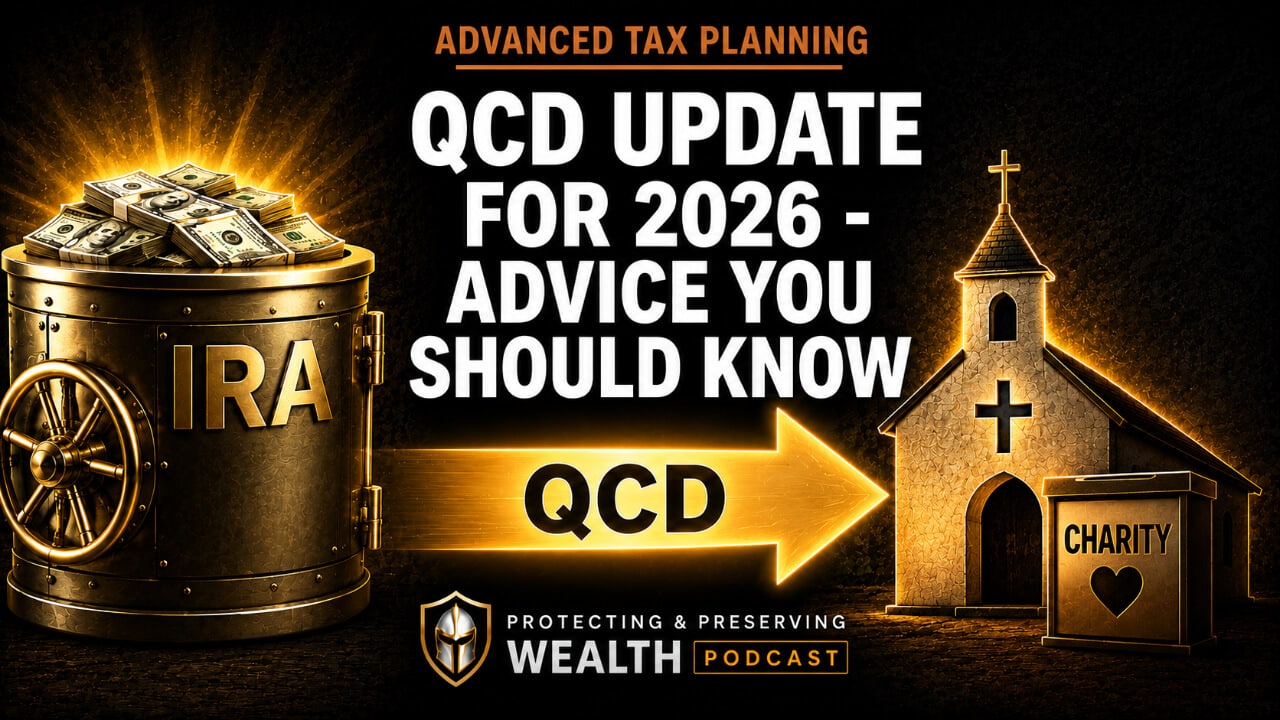
A Qualified Charitable Distribution (QCD) is a charitable gift made directly from an IRA to a charity so the distribution can be treated as non-taxable when executed correctly. In this episode, we break down what changed for 2026, who qualifies, and the process details that most often cause a QCD to fail.
Key Takeaways
You must be 70½ on the actual date the QCD is processed—being in the same tax year is not enough.
For 2026, the annual QCD limit discussed is $111,000 per person (up to $222,000 for a married couple).
A QCD must go from the IRA directly to the charity—you can’t receive the money first and then donate it.
QCDs are cash-only from the IRA (no donating stock “in kind” from inside the IRA).
Documentation matters, and a new 1099-R Box 7 Code Y may appear depending on the custodian.
What This Episode Covers
Episode 81 is a practical update on QCDs for 2026—less theory, more “here’s what breaks eligibility.” The biggest timing issue is the 70½ rule. Eligibility begins only once you’re 70½ by date, meaning a QCD can’t be done early just because you’ll turn 70½ later in the same calendar year. That one detail alone explains a lot of QCD clean-up conversations at tax time.
We also clarify how QCD timing relates to RMD timing. It’s possible to be QCD-eligible at 70½ while not yet required to take RMDs (RMD ages come later). That creates planning opportunities for people who are already charitably inclined and want to keep IRA distributions from showing up as taxable income.
Inherited IRAs come up as well. If you inherited an IRA and have a required distribution, the episode explains how a QCD may be used in lieu of taking that taxable withdrawal—provided the 70½ age requirement is met. And if an RMD has already been taken, QCD gifting can still be done later in the year up to the annual limit discussed.
From there, the episode turns into a clear execution checklist: the gift must be directly transferred from the IRA to the charity, can’t be routed to a donor-advised fund, can’t include any “benefit received,” and should be backed by clean documentation. We finish with a reporting update tied to tax preparation: a new Code Y notation in Box 7 of Form 1099-R intended to identify QCDs, though custodian usage may vary.
Eligibility
Age requirement (non-negotiable): You must be 70½ when the QCD occurs. Turning 70½ later in the same year does not qualify you earlier.
QCD eligibility can begin before RMD eligibility: It’s possible to be 70½ and still not required to take RMDs, while remaining eligible for QCDs.
Inherited IRA scenario: If you’re a beneficiary with an inherited IRA RMD requirement, a QCD can be used to satisfy that requirement as long as you’re 70½.
2026 limit discussed: $111,000 per person, potentially $222,000 for a married couple.
Planning note: The most common eligibility misunderstanding is treating 70½ like a “tax-year” milestone instead of a by-date requirement.
For Hosler Wealth Management’s broader QCD overview, see: What Are Qualified Charitable Distributions?
Execution Mechanics
Direct transfer only: The distribution must be paid to the charity, not to you. If it hits your bank account first, it’s no longer a QCD.
What it looks like in practice: Most custodians issue a check payable to the charity (often mailed directly).
IRA-sourced (not an employer plan): This is an IRA strategy—QCDs are not described here as available from employer plans like 401(k)s or 403(b)s.
Cash-only from the IRA: A QCD is done in cash. An “in-kind” stock donation from inside the IRA isn’t treated as a QCD under the rules discussed.
Roth IRA caution: The episode strongly discourages attempting QCDs from Roth IRAs due to complexity and potential taxable amounts.
Planning note: Many people remember the charitable intent but miss the “qualified” mechanics—payee, asset type, and documentation are what make it work.
Related strategy context: Moving To Tax-Free In 8 Steps | Ep #48
Common Errors / Disqualifiers
Executing the QCD before reaching age 70½
Having the distribution paid to you (or deposited to your account) and then donating separately
Routing the gift to a donor-advised fund
Receiving anything in return (a quid pro quo benefit such as a charity dinner value)
Attempting an in-kind stock donation from inside the IRA rather than making the gift in cash
Attempting to run the strategy from an employer plan like a 401(k)/403(b) (as discussed in the episode)
Planning note: Most disqualifiers are process mistakes, not “advanced tax issues”—they’re avoidable with a clean checklist.
Why This Matters
The central planning benefit discussed is simple: charitable giving can be done in a way that keeps the IRA distribution from being treated as taxable income when executed properly. Instead of taking an RMD into income and then donating it, a QCD can satisfy distribution needs while potentially avoiding income inclusion.
Downstream impacts are part of the planning discussion too—excluding income may help manage Social Security taxation, avoid IRMAA premium penalties, and preserve room in the bracket for Roth conversion planning.
Planning note: QCDs are often treated as “just a charitable move,” but the episode frames them as a lever that can affect multiple parts of the return.
(For IRMAA context referenced in the broader planning conversation: MOVING TO TAX-FREE™ Bruce’s New Book | Ep #43 )
Administrative or Reporting Notes
Charity documentation: Keep a written acknowledgment from the charity confirming receipt and stating no benefit was received in return.
1099-R update (Code Y): A new Box 7 code—Code Y—is intended to identify QCDs on Form 1099-R. Custodian usage may vary.
Planning note: Even when the transfer is done correctly, tax preparation can still get messy without clean receipts and clear communication that the distribution was a QCD.
Summary
This episode’s 2026 QCD update comes down to a few non-negotiables: eligibility starts at age 70½ by date, the transfer must go directly from the IRA to the charity, the gift is made in cash, and the paperwork must support “no benefit received.” The annual limit discussed is $111,000 per person for 2026, with additional attention to inherited IRA RMD coordination and the new 1099-R Code Y reporting cue.
Quick Answers About QCDs
What is a QCD?
A QCD is a charitable gift made by direct transfer from an IRA to a charity, intended to be treated as non-taxable when executed correctly.
Planning note: The transfer mechanics matter as much as the donation itself.What age do you have to be for a QCD?
You must be 70½ by the actual date of the transfer—not later in the same year.Can a QCD be done before RMDs begin?
Yes. QCD eligibility at 70½ can begin before RMDs are required.What is the QCD limit discussed for 2026?
$111,000 per person.Can a married couple do $222,000 of QCDs?
Yes—based on the per-person limit discussed.Can a QCD satisfy an inherited IRA RMD?
It may, as long as the beneficiary is 70½.If an RMD was already taken, can a QCD still be done that year?
Yes—QCD gifting can still be done up to the annual limit discussed.
Planning note: Many people stop planning after the RMD is taken, but the gifting window may still be open.Can you withdraw to your bank account and then donate?
No. If you take possession of the funds, it’s not a QCD.Does the check have to be payable to the charity?
Yes. The transfer must be IRA-to-charity.Can a QCD go to a donor-advised fund?
No—donor-advised fund routing is not allowed in the rules discussed.Can you receive anything in return from the charity?
No—no quid pro quo benefits; documentation should confirm no benefit was received.Can you donate stock “in kind” from the IRA as a QCD?
No—QCDs are done in cash under the execution rules discussed.Can you do a QCD from a 401(k) or 403(b)?
No—this is presented as an IRA-only strategy.Should you do a QCD from a Roth IRA?
The episode strongly discourages it due to complexity and potential taxable amounts.What is Code Y on the 1099-R?
A Box 7 notation intended to identify QCDs, though custodian usage may vary.
Planning note: Don’t rely on a form code alone—keep strong documentation regardless.
Guided Follow-Up FAQ
Timing and Age 70½
Can a QCD be done earlier in the year if you turn 70½ later that year?
No. Eligibility begins only once you’re 70½ by date.
Once the date is right, the next issue is routing.
What’s the cleanest way to ensure the transfer qualifies?
Have the IRA distribution made payable directly to the charity through the custodian.
Then protect the reporting side.
What paperwork should be kept?
Keep the charity acknowledgment stating no benefit was received, plus clear records that the payment was IRA-to-charity.
Inherited IRAs and RMDs
Can an inherited IRA RMD be satisfied with a QCD?
It may—if the beneficiary is 70½ and the transfer is executed properly.
A common question comes up after the RMD is already taken.
If the RMD is already done, is the year “over” for QCDs?
No—QCD gifting can still be completed up to the annual limit discussed.
This is where QCDs connect to broader planning.
Why does keeping income lower matter?
The episode ties it to Social Security taxation, IRMAA, and preserving bracket space for Roth conversion planning.
“Qualified” Means Process
If you receive the money first and then donate, does it count?
No. That breaks QCD treatment.
Destination matters too.
Can the QCD be sent to a donor-advised fund?
No.
Finally, keep the charity benefit clean.
What if the charity dinner includes a meal value?
That’s a benefit received; avoid quid pro quo and obtain the right acknowledgment.
Additional Educational References
A 2026 QCD, as covered in this episode, is a 70½+, IRA-to-charity, cash-only, properly documented transfer that can keep the distribution from being treated as taxable income when executed correctly.
If charitable giving from retirement accounts is part of your 2026 plan, use the checklist from this episode—age/date, direct payee, cash-only transfer, no benefits received, and clean documentation—before initiating the distribution.
For more information about anything related to your finances, contact Bruce Hosler and the team at Hosler Wealth Management. Contact Our Team: https://www.hoslerwm.com/contact-us/
Call the Prescott office at (928) 778-7666 or our Scottsdale office at (480) 994-7342.
To view all Protecting and Preserving Wealth Podcast episodes: https://www.hoslerwm.com/protectingwealthpodcast/
Limitation of Liability Disclosures: https://www.hoslerwm.com/disclosures/
Copyright © 2026 Hosler Wealth Management | All Rights Reserved. #ProtectingWealthPodcast #ProtectingandPreservingWealthPodcast #HoslerWealthManagement #BruceHosler
Produced by JAG Podcast Productions – https://www.jagpodcastproductions.com.
Host


Bruce Hosler is the founder and principal of Hosler Wealth Management which has offices in Prescott and Scottsdale, Arizona. As an Enrolled Agent, CERTIFIED FINANCIAL PLANNER® professional, and Certified Private Wealth Advisor (CPWA®), Bruce brings a multifaceted approach to advanced financial and tax planning. He is recognized as a prominent financial professional with over 29 years of experience and a eight-time consecutive *Forbes Best-In-State Wealth Advisor in Arizona. Bruce recently authored the book MOVING TO TAX-FREE™ Strategies For Creating Tax-Free Retirement Income And Tax-Free Lifetime Legacy Income For Your Children. www.movingtotaxfree.com.
In the Protecting & Preserving Wealth podcast, Bruce and his guests discuss current financial topics and provide timely answers for our listeners.
If you have a topic of interest, please let us know by emailing info@hoslerwm.com. We welcome your suggestions.
2018-2025 Forbes Best In State Wealth Advisors, created by SHOOK Research. Presented in April 2025 based on data gathered from June 2023 to June 2024. Not indicative of advisor’s future performance. Your experience may vary. For more information please visit.
Guest Profiles
Alex Koury is a CERTIFIED FINANCIAL PLANNER® professional, a CERTIFIED PRIVATE WEALTH ADVISOR (CPWA®), and holds a Certified Exit Planning Advisor (CEPA®). Working out of our Scottsdale office, he has been in the financial services industry for over 15 years. He holds Series 7, 9, 10 & 66 securities registrations– and is a Registered Representative with Mutual Group.

Jason Hosler holds Series 7 and 66 FINRA securities registrations. He brings a technological edge to our firm and helps many of our clients stay current in the fast-moving age of the internet.

Bruce Hosler, Jason Hosler, and Alex Koury were collectively recognized as 2025 Forbes Best-In-State Wealth Management Teams, reflecting their collaborative approach to comprehensive wealth, retirement, and advanced tax planning. This recognition is a fantastic milestone for us, and it inspires us to continue delivering outstanding service to our valued clients every day.
2025 Forbes Best-In-State Wealth Management Teams, created by SHOOK Research. Presented in Jan 2025 based on data as of March 2024. 11,674 Management Teams were considered, approximately 5,300 teams were recognized. Not indicative of advisor’s future performance. Your experience may vary. For more information, please visit.
Transcript
Protecting and Preserving Wealth Episode 81 – QCD Update for 2026
Speakers: Bruce Hosler, Alex Koury, & Jason Hosler & Jon Gay
[Music playing]
Jon Gay (00:04):
Welcome back to Protecting and Preserving Wealth. I am Jon Gay, joined as always by Alex Koury, Jason Hosler, and Bruce Hosler of Hosler Wealth Management. Always a pleasure to be with all three of you.
Bruce Hosler (00:13):
Jon, thanks for being with us this morning.
Alex Koury (00:15):
Good to see you again, Jon.
Jason Hosler (00:17):
Good morning, Jon.
Jon Gay (00:17):
Today, we’re talking about a 2026 QCD update. Those are qualified charitable distributions. And really, what you should know. This is going to be really important for our listeners at that stage of life.
Bruce, I know the big thing here is you have to be age 70 and a half to use that QCD, and that is really important.
Bruce Hosler (00:36):
And it’s actually 70 and a half. You can’t do it a month early just because it’s the same tax year. So, we want you to be 70 and a half before you actually make that donation out of your IRA account. A lot of people think, falsely, that they need to have to retake a required minimum distribution.
But think about it; the required minimum distributions now are normally either age 73 or age 75, depending on when someone’s born, and it’s really pre-1960 or not. You can be 70 and a half and not have a required minimum distribution, but you can still give your charitable gifts out of your IRA with a QCD.
This is a great opportunity for some of our clients. And then Jason, we’ve had some clients that asked the question at one of our client events; her aunt died and left her an IRA, and she was wondering if she could do a QCD. What’s the answer?
Jason Hosler (01:34):
Well, if you’re the beneficiary of an inherited IRA and you’ve got that required minimum distribution that you have to make, you can use a QCD in lieu of your RMD withdrawal for the year.
Bruce Hosler (01:47):
Or up to what amount?
Alex Koury (01:50):
So, this year, it’s up to $111,000 per person.
Bruce Hosler (01:55):
Exactly. In 2026, it stepped up to that. Alex. And here’s the thing, Alex, if somebody is thinking that their taxes are for tax year 2026, and so here we are early in the year, January, February, March, and they’re like, “Hey, I’m going to be 70 and a half in June, can’t they just do a QCD right now in February because it’s the same tax year?” Is that okay Alex?
Alex Koury (02:21):
No. So, what you want to do, you need to wait until you actually turn 70 and a half. So, by the date, not by the actual year. To make sure it gets recorded exactly as the QCD amount that you want to make it qualify as a QCD and a tax redistribution.
Jon Gay (02:39):
I want to recap what we’ve talked about here so far. So, you can be old enough to use a QCD before you get to the age of an RMD. I have that right? Right, Bruce?
Bruce Hosler (02:49):
Correct. That’s exactly right.
Jon Gay (02:50):
And if you’re the beneficiary of an inherited IRA and you have that RMD requirement, you can use a QCD instead of an RMD for your withdrawal for the year.
Bruce Hosler (03:01):
As long as you’re 70 and a half, that’s the catch. So, you’re the beneficiary of an inherited IRA, and you can use the QCD to fulfill that RMD requirement.
But if you’re 70 and a half and you’ve already taken the RMD, let’s say, you can still do a QCD up to the $111,000 if you want to use that for your gifting. And that’s where a lot of people miss out on the opportunity on an inherited IRA.
Jon Gay (03:26):
Really glad that we’re covering this today. So, let’s talk about calendar year. Again, as Alex and Bruce have both said; you cannot do this until you are chronologically in age 70 and a half. But assuming you are 70 and a half, let’s talk about calendar year 2026.
Bruce Hosler (03:43):
Okay. So, you use the QCD this year if you have a required minimum distribution, and the QCD can replace that, except here’s the big benefit. This is the huge benefit that people love.
Instead of having taxable income that they don’t really need and then maybe giving that to a charity, they just take their RMD and gift that to the charity, and it’s not included as taxable income. It’s not taxable to the charity either, and it can fulfill your RMD.
And so, you didn’t increase your income, you got to give it to your charity, and the charity didn’t pay any taxes. It’s a win-win-win.
Jon Gay (04:19):
Says the man who wrote the book Moving to Tax-Free.
Alex Koury (04:21):
That’s right. One thing I want to just clarify on as well is: Bruce mentioned taking the money out of the IRA as a QCD. So, when you do that, on your form, you must have those checks endorsed to that charity as a distribution from your IRA.
You cannot take hold of the money in your name, put it in your bank account, and then turn around and write the check to the charity of your choice. That does not qualify as a QCD. It has to come from the IRA endorsed directly to the charity. Typically, your broker will send it right to them for you.
Jon Gay (04:53):
So, it’s a little bit like when you do a rollover. It has to be made out to the proper entity as opposed to you personally.
Bruce Hosler (05:00):
Correct. It’s not paid to you; it’s paid to the charity. And so, that way, they know that it went to the charity, and the custodians now are wanting to make those payments directly to the charity.
Jon Gay (05:13):
And you mentioned earlier that the QCD limitation for 2026 is $111,000. So, a married couple really could give away as much as $222,000, right?
Bruce Hosler (05:22):
They can give that much away if they’re trying to give their money charitably. The IRA with a QCD is the very best vehicle to give money away. And we’re going to talk about some of the new rules on that this year that went into effect, why QCDs are better, in our next podcast.
Jason Hosler (05:42):
Jon, another reason that people might want to roll over a 401(k)-retirement plan into a traditional IRA or a Roth IRA, if they’ve got that post-tax portion, it allows them to be able to use a QCD. So, the QCD has to come directly from an IRA and go to that qualified charity.
You’re not allowed to do that from those employer-sponsored plans like 401(k)s or 403(b)s. So, it’s another tool in your bucket that might be of interest to you when you’re deciding whether to retain funds in a 401(k) or roll out to an IRA.
Jon Gay (06:19):
I want to come back to a point we made earlier, which is about how the money can’t go to you, and then the charity. It’s really important that it goes directly. And that includes it can’t go to your own donor-advised fund. And then also, you can’t get anything from the charity. There’s no quid pro quo here.
Bruce Hosler (06:36):
Yeah, a lot of times you make a donation at a charitable ball or something like that and you give money, and you get to attend. Well, you and your spouse got that meal worth $75 a plate, and you got some benefit.
It’s really important that there’s a letter that comes from the charity and says you received no financial benefit for this QCD gift that you gave to the charity. And that’s why the custodians have tightened this up because I think they’re making a gift, and there’s no strings attached, and that’s very clear.
And then the charity, once they receive that check, as a taxpayer, you want to make sure you get that receipt back saying, “Hey, we’ve received this money, and you as the donor have not received any benefits.”
Jon Gay (07:27):
Only $75 a plate? What charity dinners are you going to, Bruce? I would’ve expected that number to be much higher (laughs).
Bruce Hosler (07:34):
Well, it probably is, but it’s a rubber-chicken dinner, so what can I say?
Jon Gay (07:40):
I have way too many of those in my life (laughs).
Bruce Hosler (07:42):
Yes. Yes. Now one of the things that we want to talk about is that QCDs can only be made through a direct transfer of IRA funds. And when I say funds, I’m not saying mutual funds, I’m saying cash funds. And so, this can only be made with a cash payment from your IRA to the charity.
You cannot make a donation in kind. If you have Apple stock, you can’t say, “Well, just give them some Apple stock out of my IRA.” No. You have to sell that in the IRA, and then the charity has to give, or the IRA custodian has to give, cash to the charity. That’s very important.
Also, due to complex nature, sometimes a Roth IRA can have some taxable amounts in it. It’s so complex and so hard, we recommend hardcore that you do not try and make one of these QCD donations out of a Roth IRA.
So, if you have a Roth IRA, we don’t want you trying to do QCD donations out of it, you’re better off doing that out of other accounts.
Jason Hosler (08:50):
And often, Jon, for our clients that are utilizing QCDs, one of the big reasons is that they’re trying to exclude those distributions from taxable income. And so, most of our clients will have both traditional IRAs and Roth IRAs. They’ll be in the process of moving to tax-free or making Roth conversions every year.
So, there’s a few reasons that we want to exclude that income. So, number one, it could keep your social security from being taxable. It can help you stay below the IRMAA penalties. Those are kind of a cliff for a lot of people that they don’t pay attention to until they get their social security for the next year, and they’re like, “Why is my deduction bigger?”
Bruce Hosler (09:30):
So, hold on, Jason, let’s just clarify for our audience, our listeners, so they know IRMAA stands for income-related monthly adjustment amount.
This is the premium penalty that they take out of your social security benefits if you’re old enough to receive social security and receiving it. Or if you’re on Medicare, you have to pay an extra premium over the regular premium because you make too much money.
Jason Hosler (09:52):
Now, in 2026, we’re also going to have this new senior deduction. So, for a married filing joint couple, that phase-out is from $150,000 to $250,000 adjusted gross income.
So, if you’re able to make a QCD and bring down the income that you have to recognize, you might qualify for that new deduction within that range. And it could help you stay below the level that you need to qualify for the QBI deduction for any self-employed business owners.
Bruce Hosler (10:22):
QBI, qualified business income deduction for business owners, guys. That’s that 20% if you have an S-corporation or a partnership or sole proprietorship. So, that’s a big deduction. You don’t want to lose that deduction.
Jason Hosler (10:34):
Saving the best for last. Most importantly, for a lot of our clients who are moving to tax-free, we free up more of the tax bracket to use for our Roth conversions if we don’t have to recognize that income.
Bruce Hosler (10:46):
This is the new thing for 2026. It is the new 1099 Report. What’s going on there, Alex?
Alex Koury (10:54):
That’s right. So, the IRS announced that there’s a new code, Code Y (as in Yankee), for Box 7 of the 1099-R you receive when you make your distributions from your IRA. It’s available for 2025 tax returns as well. But this is also something optional.
But what’s important, though, is this code is specifically for QCDs, your qualified charitable distributions. So, I would think everyone will want to make this notation on their 1099-R when they receive it so that when your tax preparer or you know and remember that “Hey, we made a QCD for the year, it’s non-taxable.”
Bruce Hosler (11:30):
And the big deal is here, they made it required, and then in October of ‘25, they said, “Well, it’s optional for the custodians.” So, some of the custodians this year may be having that code on the 1099-R for the QCD, some of them may not, but for 2026, we can now make sure that you’re catching that, and you realize, “Hey, that distribution was not taxable.”
Jon Gay (11:55):
The keys here are document, document, document. Because this stuff, as you alluded to Bruce, it’s so complicated. You want to talk to a professional that deals in these types of things.
If one of our listeners or viewers wants to talk to you and your team at Hosler Wealth Management, how do they best find you?
Bruce Hosler (12:10):
Well, certainly, they can find us on the website at hoslerwm.com. If they want to call us, Jason, where do they call in Prescott?
Jason Hosler (12:20):
Give us a call at (928) 778-7666.
Bruce Hosler (12:24):
And in Scottsdale, Alex, if they want to call you, how do they get you?
Alex Koury (12:27):
Yep, (400) 994-7342.
Jon Gay (12:32):
Great stuff, gentlemen. We’ll talk to you again in a couple weeks.
Bruce Hosler (12:34):
Thanks, Jon.
Jason Hosler (12:35):
Thanks, Jon.
[Music playing]
Disclosure: (23:50):
Investment advisory services are offered through Mutual Advisors LLC, DBA Hosler Wealth Management, a SEC registered investment advisor. Securities are offered through Mutual Securities, Inc., a member FINRA/SIPC. Mutual Advisors, LLC and Mutual Securities, Inc. (collectively Mutual Group) are affiliated companies.
Forward-looking commentary should not be misconstrued as investment or financial advice. The advisor associated with this podcast is not monitored for comments, and any comments should be given directly to the office at the contact information specified.
Any tax advice contained in this communication, including any attachments, is not intended or written to be used and cannot be used for the purpose of 1) avoiding federal or state tax penalties; 2) promoting marketing or recommending to another party any transaction or matter addressed herein; and 3) tax preparation and accounting services are offered independently through Hosler Wealth Management Tax Services.
Any tax advice provided by tax professionals under Hosler Wealth Management Tax Services is separate and unrelated to any advisory or security services offered through Mutual Group. The accuracy, completeness, and timeliness of the information contained in this podcast cannot be guaranteed. Mutual Group does not provide tax or legal advice. You should consult a legal or tax professional regarding your individual situation.
Accordingly, Hosler Wealth Management does not warranty, guarantee or make any representations or assume any liability with regard to financial results based on the use of the information in this podcast.
Be The First To Know About New Podcast Episodes!
"*" indicates required fields