
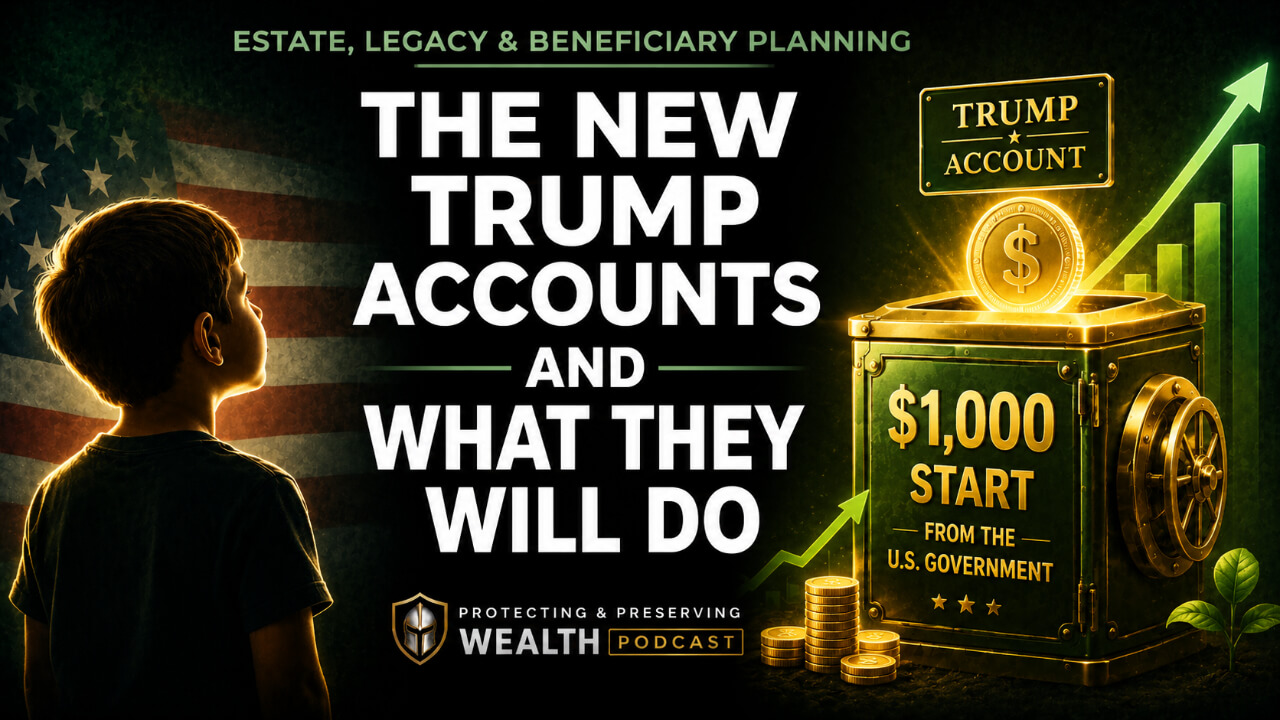




Trump Accounts Explained: A New Way to Build Generational Wealth From Childhood

Share:


Table of Contents
Most Americans don’t begin investing seriously until adulthood—often after their first job, their first paycheck, or their first financial mistake. That may be about to change.
A new type of account, commonly referred to as a Trump Account, is scheduled to launch beginning in July 2026, and it represents something entirely new in U.S. financial policy: a tax-deferred investment account available to children—even without earned income.
If implemented as outlined, Trump Accounts could fundamentally reshape how families think about saving, investing, and teaching financial literacy across generations.
What Are Trump Accounts?
Trump Accounts were introduced as part of the One Big Beautiful Bill Act (OBBBA) and are designed to give children an early entry point into the capital markets.
Under the current framework:
- Children born between January 1, 2025 and December 31, 2028 will receive an automatic $1,000 contribution from the federal government
- Accounts will officially open beginning July 2026
- Children under 18 may also have accounts established by parents or grandparents
What makes these accounts remarkable isn’t just the initial funding—it’s how early investing can begin and how long tax-deferred growth can compound.
The Biggest Breakthrough: No Earned Income Required
Historically, tax-advantaged retirement accounts like IRAs and Roth IRAs required earned income.
That meant:
- No job → no IRA
- No wages → no tax-deferred growth
Trump Accounts remove that barrier.
For the first time, children can have tax-deferred investment accounts without needing a paycheck. This alone makes Trump Accounts unprecedented.
Instead of waiting until age 16, 18, or later to begin investing, compounding can begin from birth.
Why Time Is the Real Advantage
When people talk about investing, returns get most of the attention. But professionals know the real driver of wealth is time.
Trump Accounts introduce:
- Up to 18 years of uninterrupted, tax-deferred growth
- Contributions that can compound before adulthood
- Early exposure to how markets work
Even modest annual contributions, when compounded over nearly two decades, can grow into substantial balances—long before most people ever open their first retirement account.
This isn’t about speculation. It’s about math, discipline, and time value of money.
How Trump Accounts Must Be Invested
Another defining feature of Trump Accounts is where the money must be invested.
Before age 18, contributions must be allocated to:
- Low-cost mutual funds or ETFs
- Indexes primarily composed of U.S.-based companies
Think broad American stock market exposure rather than individual stock picking.
This design:
- Encourages diversification
- Reduces speculation
- Anchors growth to the long-term performance of U.S. businesses
In effect, every participating child becomes a long-term investor in American enterprise.
Contributions From Parents, Grandparents, and Employers
Trump Accounts aren’t limited to government funding.
As currently outlined:
- Parents or grandparents may contribute up to $5,000 per year
- Employer contributions of up to $2,500 per year may be allowed
- Contribution limits are indexed for inflation
Employer contributions are particularly noteworthy because:
- They do not count as taxable income to the employee
- They may become a new form of family-oriented workplace benefit
This introduces an entirely new planning conversation around employee retention, family benefits, and long-term financial wellness.
What Happens When the Child Turns 18?
Once the child reaches age 18:
- The account begins operating similarly to a traditional IRA
- Standard IRA withdrawal rules apply
- Early withdrawals may be subject to penalties
Importantly:
- There are no withdrawals permitted before age 18
- This creates a built-in lesson in delayed gratification
While access at 18 gives flexibility, penalties still discourage impulsive decisions—encouraging long-term thinking rather than short-term spending.
Teaching Financial Literacy Through Ownership
One of the most powerful aspects of Trump Accounts isn’t financial—it’s behavioral.
These accounts introduce children to:
- Investing, not just saving
- Market growth, not instant gratification
- Ownership in businesses, not consumption
Instead of learning about money only after mistakes are made, children grow up watching their own account compound.
That experience can shape:
- Risk awareness
- Patience
- Long-term decision-making
This is financial education through real-world participation—not textbooks.
A New Tool for Legacy Planning
From a multigenerational perspective, Trump Accounts open new doors.
Grandparents, in particular, may see them as:
- A legacy vehicle
- A teaching tool
- A way to transfer values alongside wealth
Rather than leaving inheritance discussions for later in life, families can begin conversations about investing, discipline, and growth while children are young.
Why Awareness Matters Now
Although Trump Accounts won’t be available until 2026, planning starts long before accounts open.
Families should begin thinking about:
- Which children may be eligible
- How contributions might fit into existing strategies
- How these accounts interact with other planning tools
As regulations evolve, early awareness creates better positioning—not rushed decisions.
Final Thoughts: A Generational Shift in Investing
Trump Accounts represent more than a new financial product.
They signal a shift toward:
- Earlier investing
- Broader participation
- Financial education through ownership
For families who understand the power of compounding and long-term planning, these accounts may become one of the most meaningful tools introduced in decades.
This is not about politics.
It’s about time, opportunity, and generational momentum.
*Additional Reading References:
How Trump Accounts Work — Ed Slott & Company, LLC. This article explains the basics of Trump Accounts, contribution rules, investment requirements, and how they operate before and after age 18 from a tax-education perspective rooted in IRA guidance.
IRS Addresses Unanswered Questions About Trump Accounts — The Slott Report. Ed Slott’s Slott Report covers newly released IRS guidance (Notice 2025-68) clarifying establishment procedures, contribution limits, Roth conversion possibilities, and required minimum distributions — giving you authoritative, technical context straight from tax-education experts.
For more information about anything related to your finances, contact Bruce Hosler and the team at Hosler Wealth Management. Contact Our Team: https://www.hoslerwm.com/contact-us/
Call the Prescott office at (928) 778-7666 or our Scottsdale office at (480) 994-7342.
To view all Protecting and Preserving Wealth Podcast episodes: https://www.hoslerwm.com/protectingwealthpodcast/
Limitation of Liability Disclosures: https://www.hoslerwm.com/disclosures/
Copyright © 2026 Hosler Wealth Management | All Rights Reserved. #ProtectingWealthPodcast #ProtectingandPreservingWealthPodcast #HoslerWealthManagement #BruceHosler
Host


Bruce Hosler is the founder and principal of Hosler Wealth Management which has offices in Prescott and Scottsdale, Arizona. As an Enrolled Agent, CERTIFIED FINANCIAL PLANNER® professional, and Certified Private Wealth Advisor (CPWA®), Bruce brings a multifaceted approach to advanced financial and tax planning. He is recognized as a prominent financial professional with over 29 years of experience and a eight-time consecutive *Forbes Best-In-State Wealth Advisor in Arizona. Bruce recently authored the book MOVING TO TAX-FREE™ Strategies For Creating Tax-Free Retirement Income And Tax-Free Lifetime Legacy Income For Your Children. www.movingtotaxfree.com.
In the Protecting & Preserving Wealth podcast, Bruce and his guests discuss current financial topics and provide timely answers for our listeners.
If you have a topic of interest, please let us know by emailing info@hoslerwm.com. We welcome your suggestions.
2018-2025 Forbes Best In State Wealth Advisors, created by SHOOK Research. Presented in April 2025 based on data gathered from June 2023 to June 2024. Not indicative of advisor’s future performance. Your experience may vary. For more information please visit.
Guest Profiles

Alex Koury is a CERTIFIED FINANCIAL PLANNER® professional, a CERTIFIED PRIVATE WEALTH ADVISOR (CPWA®), and holds a Certified Exit Planning Advisor (CEPA®). Working out of our Scottsdale office, he has been in the financial services industry for over 15 years. He holds Series 7, 9, 10 & 66 securities registrations– and is a Registered Representative with Mutual Group.

Jason Hosler holds Series 7 and 66 FINRA securities registrations. He brings a technological edge to our firm and helps many of our clients stay current in the fast-moving age of the internet.

Bruce Hosler, Jason Hosler, and Alex Koury were collectively recognized as 2025 Forbes Best-In-State Wealth Management Teams, reflecting their collaborative approach to comprehensive wealth, retirement, and advanced tax planning. This recognition is a fantastic milestone for us, and it inspires us to continue delivering outstanding service to our valued clients every day.
2025 Forbes Best-In-State Wealth Management Teams, created by SHOOK Research. Presented in Jan 2025 based on data as of March 2024. 11,674 Management Teams were considered, approximately 5,300 teams were recognized. Not indicative of advisor’s future performance. Your experience may vary. For more information, please visit.
Transcript
Protecting and Preserving Wealth Episode 80 – The New Trump Accounts and What They Will Do
Speakers: Jon Gay, Bruce Hosler, Jason Hosler, & Alex Koury
[Music Playing]
Jon Gay (00:05):
Welcome to Protecting and Preserving Wealth. I’m Jon Jag Gay, joined as always by Alex Koury, Jason Hosler, and Bruce Hosler of Hosler Wealth Management. Hello, gentlemen.
Bruce Hosler (00:12):
Good morning.
Jason Hosler (00:13):
Good morning, Jon.
Alex Koury (00:14):
Hi, Jon, good morning.
Jon Gay (00:15):
This is like Charlie’s Angels, I say good morning and everybody says good morning (laughs).
Alright, today we’re talking about Trump Accounts. Obviously, our listeners are probably familiar with Roth accounts. We’re talking about Trump Accounts, which is a new entity. So, Bruce, how do we start here?
Bruce Hosler (00:28):
So, these came out of the OBBBA, and that’s why I wanted to talk about them today. You can’t actually set one up yet, they’re going to be set up in July of 2026, is when the first ones will be set up. Children that are born I believe starting in January of ‘25, all the way through December 31st of ‘28 will receive $1,000 contribution from the federal government to be made and set up this Trump Account.
What I’m mostly excited about is we’re going to have a whole new generation of capitalists because can you imagine these kids when they turn 18 to 20 years old, if they have an account that’s worth perhaps as much as $300,000, that is just amazing.
Jon Gay (01:13):
The side note here, Bruce, is a big topic lately has been the need for educating high schoolers and middle schoolers and kids, this would be one way to do it, you’ve got this money to play with now.
Bruce Hosler (01:26):
Right, right. And really, we just want to bring the awareness of these accounts to our clients and I realize, for example, I don’t have any grandchildren of that age, but I have grandchildren that are still under 18, and they can have these accounts set up for them after July 4th, 2026.
What do I do as a grandparent? What do I do as a parent if I want to set up one of these accounts? I want to make our listeners aware of this that it’s coming so they can begin to prepare for it.
Jason Hosler (01:57):
This is a very interesting proposal from a policy perspective because not only are all the children born over the next four years during the Trump administration here are going to be having that initial $1,000 deposit, but you’re also going to be able to have all the kids under 18 have eligibility to be able to participate in these accounts. I think this is going to create much more widespread participation for minors, and not under the previous rules.
A lot of the other accounts that parents or grandparents have access to for minors are restricted in some way used for education, the Uniform Transfer to Minors Act accounts have different types of restrictions, and there’s still a lot of unknowns about this. How some of the tax reporting’s going to be made, how the accounts are actually going to be established themselves, are there going to be rollover options to retirement accounts-
Bruce Hosler (02:57):
Or Roth conversion options.
Jason Hosler (03:00):
Even Roth conversion options, which could be very powerful when you think about it, especially based on some of the projections that the White House has put out. All of that together is invested in America because the limitation is that you have to invest in a US-based American Stock Index.
So, most of our listeners will be familiar with the Dow Jones or the S&P 500, but we would assume that that’s likely to include the NASDAQ 100, the Russell 2000, maybe even the Wilshire 5000, which is like a total stock market index. Those are all very popular indices and the investment in American companies by American citizens like Bruce says, makes all of these children budding capitalists.
Alex Koury (03:47):
So, if you think about it, again, the tools available today, they’re good tools, everyone generally knows about custodial accounts, 529 accounts, et cetera, but this is going to be another add-on. If you think about just time value of money, if you can help your children, and I think about this for my own daughter to be quite honest.
It’s do I want her to struggle with money in the future when there’s probably other problems that she could be worrying about or focusing on in some of the way we help the world. We give that our kids a head start this way and save now. You save less over many, many years, over many, many decades, results in more money, compounding effect really works in that way.
And I think about how legacies are built, how families of great wealth are built over not just years, but over decades and centuries and generations. You know this is opportunity for everyone to get a chance to get their foot in the door, have this initial account set up for them if your kids are under the age of 18, and start contributing and start thinking about their future as well, and we can make a big difference across this country.
And like Bruce says, raise new capitalists, raise new people in a new way to think about money differently versus waiting until you’re 18 to get involved. Get involved now, and as Jason was saying, we’re investing in US-based companies, that’s a big, big vote of confidence for America too.
Bruce Hosler (05:11):
Guys, here is the big differentiator of Trump Accounts, and this is what everybody needs to realize. Prior to Trump Accounts, children were not qualified to set up or open an IRA or a Roth IRA unless they met the requirement of earned income. They have to have earned income. And so, an IRA or a Roth IRA (one being tax deferred and the other one being tax-free), those types of accounts were not available for children and most children don’t really start working until 16, 17, 18.
So, you’ve got 16 to 18 years there of tax deferred growth that you’re not taking any money out, that you’re letting that account grow and become something, that now all of a sudden, children without unearned income can set up a tax deferred account and grow something big toward the future. This is an amazing breakthrough. It has never been available in the American system to have this tax deferred account.
And when they turn 18, essentially, it becomes a traditional IRA and subject to all of those rules. Well, here, they have had 18 years to be able to do that, and imagine if parents or grandparents or your employer (think about that) can contribute $2,500 to this, the parents or the grandparents can put up to $5,000 a year into one of these accounts, and every, year they’re growing compounding $5,000 a year and growing.
This could be an amazing opportunity for kids to become interested in their own account and interest, and learn how tax deferred growth and how the time value of money works. It is an amazing change from anything else that we’ve ever had before.
Jason Hosler (06:57):
I would also like to point out that the employers who are making that annual contribution to a Trump Account, that contribution does not impact the employee’s taxable income. So, employers are going to be able to offer this as a benefit to their employees that they’re making contributions to Trump accounts that goes towards the kids, the parents don’t have to count that in their income that year.
Jon Gay (07:18):
And in an economy that’s been up and down a lot in these last few years, if that gives an employer another edge when they’re trying to recruit top talent, there you go.
Bruce Hosler (07:27):
Absolutely. And this $5,000 is indexed for inflation. So, starting in 2026, it’s $5,000, but every year after that, it’s indexed. So, as the inflation goes up, there’ll be able to be more money put away in one of these accounts.
Alex Koury (07:42):
That’s a big deal. I think the other interesting deal is that last week, it was announced that Michael Dell and his wife made a big, big pledge to give money philanthropically to potentially help fund these types of accounts and or get this jump started. Well, that could be just this tip of the iceberg. I think there is a recognition among those that are the wealthiest in our country of trying to find ways to give money back.
This could be a good way to, again, talk about a little bit of redistribution of wealth because they get a tax break for it, it’s a charitable deduction for them, but also feeds those that again, can benefit from having these stats and just getting these things funded and making it more of a national attention issue, not just something that’s been kind of swept under the rug for so many years because, well, you don’t fund these accounts, obviously now is a way to actually give back to Americans as well.
Bruce Hosler (08:36):
Well, it’s interesting, Alex, that you say that because you just introduced a new concept. Michael Dell introduced a concept that the American people didn’t know, and that it’s not in the law so far that we know. If you give money to the government, is that a taxable donation?
Well, normally, you pay taxes. Well, Michael Dell’s giving $6 billion (him and his wife, $6 billion) and they’re going to take a charitable donation because this is going into the Trump Accounts. So, now we know something new that there is a charitable donation available for people that want to give to these Trump Accounts for multiple recipients.
Now, I don’t know if there’s going to be some limitation of, well, if you give to your grandchildren, do you get a deduction for that? Oh no, they’re related to you, or is it just because you gave it to everybody as a whole?
They’ve got to figure out, there’s a lot of regulations we got to understand here, but there could be some very cool laws that come out of this. Hey, that’s charitable if you give to the Trump Account fund or whatever, and it goes to a bunch of children, then you can take a charitable donation on that. That is very cool.
Jon Gay (09:47):
Bruce, do you mean charitable deduction or donation?
Bruce Hosler (09:50):
Charitable deduction and a charitable donation. So, you made a charitable donation that qualifies for the deduction. And so, it’s both of them really, you’re doing both, but the deduction is what I was interested in there.
The next thing that I want to point out is that it doesn’t have to be just the parents, grandparents can be doing this. What a legacy that you’re leaving for your grandchildren by funding their Trump Account every year while they’re growing up.
And I have grandchildren that are not born in ‘25, they’re older, they’re already 3, 6, 7, 9. I’m looking forward to being able to help fund their Trump Accounts and help them understand and look at their accounts and learn about money
Alex Koury (10:34):
Allowing opportunity for wealthy Americans to get these charitable deductions and give money philanthropically. Again, they don’t sell assets, they have ways and there are ways within many different levels of wealth to avoid the taxation of your assets and pass more on to your own heirs and beneficiaries, whatever have you.
Maybe part of that problem has been that these wealthier Americans, they just don’t want to pay the taxes to the government. They think there’s other better, useful ways to give their money away, and this could be that one of those opportunities to do that, think about it that way. No one wants to pay their taxes any longer, they’d rather give the money to the causes they feel are most impactful and based on their own values system.
Bruce Hosler (11:15):
Very good. I want to point out- there’s a couple laws that are kind of important. So, distributions after age 18 follow the IRA withdrawal rules, but here’s an important one. Before the first day of the calendar year in which the child turns 18, contributions must be invested in low-cost mutual funds or exchange traded funds that track the S&P stock index or another index comprised primarily of US companies.
So, here’s the point; if your child is born in June, you don’t wait until June, the year they turn 18. You have to do it the year while they’re still 17 before January 1st comes along. And you think, “Well Bruce, that’s not going to be for a while.”
Well, excuse me, when we get into 2026 in July 4th and they open up these accounts and you can start funding that, if you have a 17-year-old, you want to be sure and fund that before December 31st of that year because the year next year, that kid turns 18, you can’t fund that Trump Account.
So, these are just some rules that I want to make sure we’re bringing to the listeners, and we’re going to bring more information on this as it becomes clear, but I’m bringing this awareness now. I want to because these are going to be very cool accounts.
Your kids don’t have to have earned wages, they can have a Trump Account, it can grow tax deferred, it can grow big, it can be a game changer, and certainly, it can help teach them about money, saving money, time value of money, and growing wealth and learning how to save.
We’re an instant gratification society. Isn’t this a great lesson to teach kids, hey, this is money that you never touch. Even though it’s yours and you could touch it, you don’t because it’s growing tax deferred, what a great concept.
Jason Hosler (13:05):
Well, and there’s no withdrawals allowed until they reach the age 18 as well. So, that lesson in delayed gratification is forced on all those children. At 18, then they’re going to be making their own decisions and we know 18-year-olds don’t always make the best decisions, but there’s going to be a percentage who are going to be able to continue to save and watch this account grow and put it towards the retirement.
There’s going to be those who are going to school who this will help them out, there’s going to be those who need to buy a house or some other type of need that they have where this is going to come into play.
Bruce Hosler (13:42):
Well, and Jason, I mean an 18-year-old or a 20-year-old going to school or buying a house or buying a car, how much wages and income do they have? So, it’s not totally terrible that they take it out and their income is low. But here’s the problem, there’s a 10% early withdrawal penalty that applies if you’re less than 59 and a half.
So, there’s still a disincentive to take that out early. Even though your income may be low, there’s an incentive to keep it and let it work toward retirement.
Jon Gay (14:12):
Well, Bruce, I know you literally wrote the book Moving to Tax-Free, so I appreciate that you and the team are staying abreast of all these new developments even before we know how all of it’s going to shake out. I know we’re going to do future episodes, I’m sure, throughout 2026 as we get more information on these Trump Accounts.
In the meantime, if one of our listeners or viewers wants to talk to you or your team at Hosler Wealth Management about anything related to their financial future, what are the best ways to find you?
Bruce Hosler (14:35):
Well, Jason, they can call us at Prescott where?
Jason Hosler (14:37):
(928) 778-7666
Bruce Hosler (14:40):
In Scottsdale, Alex, if they want to call you, where do they call?
Alex Koury (14:44):
(480) 994-7342.
Bruce Hosler (14:48):
And folks, of course, you can always reach us on the website, hoslerwm.com. There’s a place in the top right that you can schedule an appointment, and we can get with you and help answer your questions.
Jon Gay (14:58):
Always appreciate the time, gentlemen. We’ll talk again soon.
Bruce Hosler (15:00):
Thanks.
Jason Hosler (15:01):
Thanks, Jon.
Alex Koury (15:01):
Thanks Jon.
[Music Playing]
Disclosure: (23:50):
Investment advisory services are offered through Mutual Advisors LLC, DBA Hosler Wealth Management, a SEC registered investment advisor. Securities are offered through Mutual Securities, Inc., a member FINRA/SIPC. Mutual Advisors, LLC and Mutual Securities, Inc. (collectively Mutual Group) are affiliated companies.
Forward-looking commentary should not be misconstrued as investment or financial advice. The advisor associated with this podcast is not monitored for comments, and any comments should be given directly to the office at the contact information specified.
Any tax advice contained in this communication, including any attachments, is not intended or written to be used and cannot be used for the purpose of 1) avoiding federal or state tax penalties; 2) promoting marketing or recommending to another party any transaction or matter addressed herein; and 3) tax preparation and accounting services are offered independently through Hosler Wealth Management Tax Services.
Any tax advice provided by tax professionals under Hosler Wealth Management Tax Services is separate and unrelated to any advisory or security services offered through Mutual Group. The accuracy, completeness, and timeliness of the information contained in this podcast cannot be guaranteed. Mutual Group does not provide tax or legal advice. You should consult a legal or tax professional regarding your individual situation.
Accordingly, Hosler Wealth Management does not warranty, guarantee or make any representations or assume any liability with regard to financial results based on the use of the information in this podcast.
Be The First To Know About New Podcast Episodes!
"*" indicates required fields