
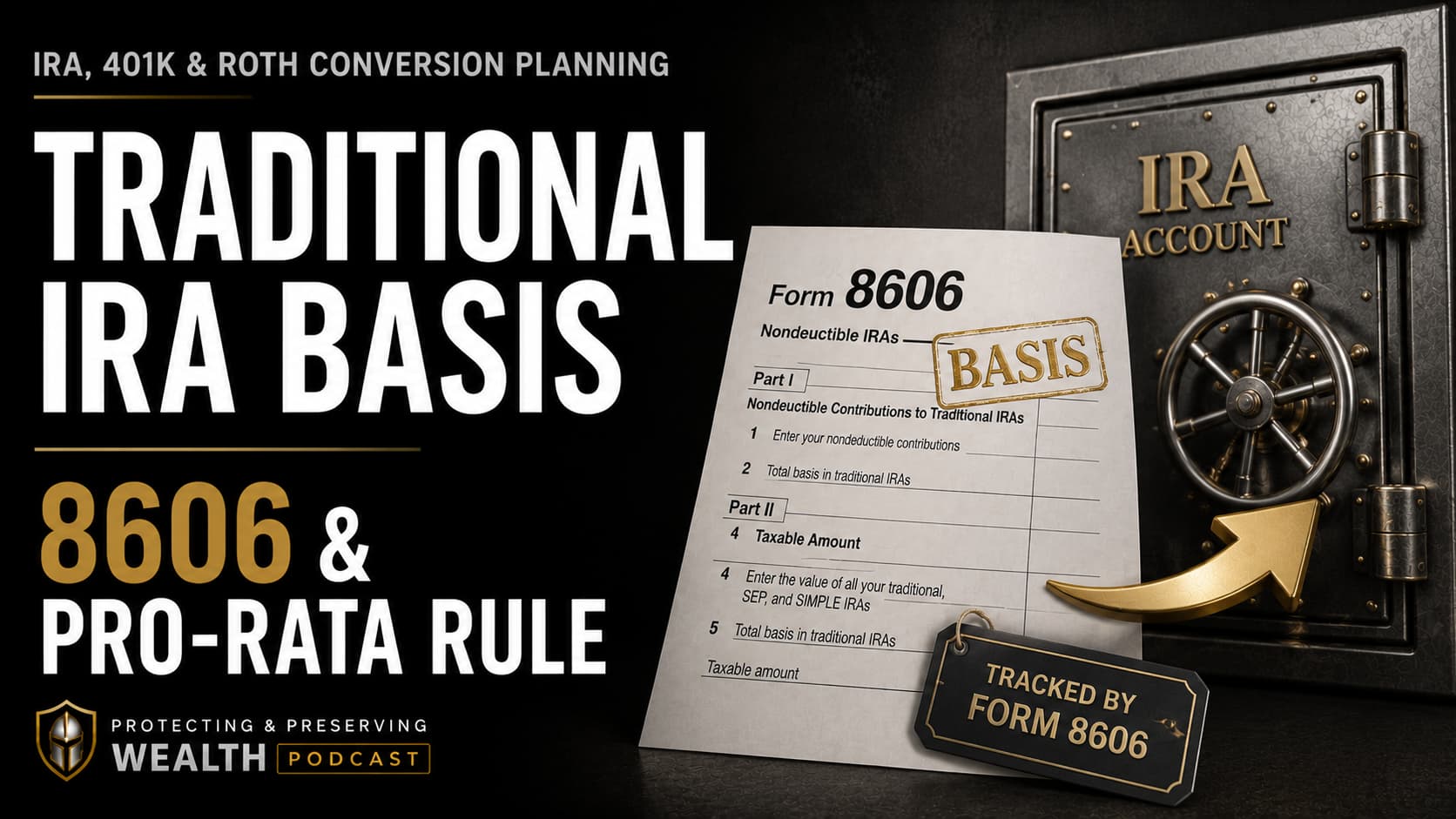




Traditional IRA Basis, Form 8606, and the Pro-Rata Rule: How Double Taxation Can Happen

Share:


Table of Contents
Traditional IRA basis represents money inside an IRA that has already been taxed. Without an accurate record of that basis, those same dollars can potentially be taxed again when distributions are taken.
That is why Form 8606 matters.
Basis can arise from nondeductible IRA contributions, contributions that ultimately cannot be deducted, or after-tax employer-plan dollars rolled into a traditional IRA. Once after-tax dollars are mixed with other traditional IRA money, the pro-rata rule generally determines how much of a distribution is taxable and how much represents a return of previously taxed basis.
The recordkeeping responsibility ultimately belongs to the taxpayer—not the IRA custodian. That responsibility becomes especially important after changing tax professionals, when older tax returns are unavailable, or when an inherited IRA contains basis a beneficiary may not know exists.
Traditional IRA basis is therefore more than a contribution-year tax issue. It can affect distributions, Roth conversions, recordkeeping, and eventually the taxation of an inherited IRA.
Hosler Wealth Management approaches retirement accounts as part of a broader financial and tax-planning picture. Explore Hosler Wealth Management
Quick Answers About Traditional IRA Basis
What is basis in a traditional IRA?
Traditional IRA basis is money inside the IRA on which income tax has already been paid. It is different from the cost basis normally associated with stocks, real estate, or other taxable investments.
Planning note: IRA basis identifies previously taxed dollars, not the purchase price of investments held inside the account.
Why does traditional IRA basis matter?
Basis matters because those dollars have already been taxed. If the basis is not properly tracked, a later distribution can potentially cause the same money to be taxed again.
Planning note: Preserving the basis record is what keeps previously taxed dollars identifiable.
How can traditional IRA basis be created?
A nondeductible IRA contribution creates basis. Basis can also arise when a contribution intended to be deductible becomes nondeductible or when after-tax employer-plan dollars are rolled into a traditional IRA without being segregated from pre-tax funds.
Can IRA basis be withdrawn first?
Generally, no. Once basis is mixed with other traditional IRA dollars, the after-tax portion cannot simply be designated as the first money distributed.
The pro-rata rule determines the proportionate taxable and nontaxable amounts.
Does the pro-rata rule apply separately to each IRA?
No. Form 8606 considers IRA balances across institutions for the calculation discussed here.
Planning note: Holding basis in one IRA and other traditional IRA money somewhere else does not, by itself, isolate the basis.
Does traditional IRA basis grow?
No. Traditional IRA basis stays level rather than increasing with investment growth.
Growth inside the IRA remains on the tax-deferred side and is taxable when distributed.
Who is responsible for tracking traditional IRA basis?
The taxpayer is ultimately responsible. The IRA custodian does not maintain the taxpayer’s Form 8606 basis history.
Planning note: Changes in custodians or tax professionals make preservation of historical tax records particularly important.
What happens to basis in an inherited IRA?
Traditional IRA basis carries into the inherited IRA rather than disappearing at death. When multiple beneficiaries inherit the account, the basis is divided proportionately among them.
Planning note: The IRA account can transfer without the supporting Form 8606 history automatically following it.
Traditional IRA Basis Is Previously Taxed Money
Traditional IRA basis starts with an important distinction: basis inside an IRA is not the same as the cost basis of an investment. It represents money that entered the traditional IRA after income tax had already been paid.
That distinction becomes important when distributions begin because previously taxed basis should not be taxed a second time.
- Basis represents after-tax money inside a traditional IRA.
- Basis is different from the purchase price of stocks or other investments.
- Taxable traditional IRA distributions are treated as ordinary income rather than capital gains.
- The portion representing basis has already been taxed.
- An accurate historical record is necessary to establish how much basis remains.
The risk of double taxation is largely a recordkeeping problem. Legitimate basis can exist inside an IRA for years, but the tax treatment becomes difficult to preserve if the amount can no longer be established.
That is particularly important when nondeductible contributions were made many years earlier. The investment account may still be easy to locate. The tax form documenting why part of that account has already been taxed may be much harder to find.
How Traditional IRA Basis Gets Created
Traditional IRA basis can arise intentionally or unintentionally. The common denominator is that money enters the traditional IRA without generating an income-tax deduction.
Three situations are especially important.
- A nondeductible traditional IRA contribution. No deduction is taken for the contribution, so the contribution creates basis.
- A contribution that ultimately cannot be deducted. A contribution may initially be intended as deductible, but income for the year can prevent the deduction. If the contribution is not withdrawn or recharacterized by the applicable correction deadline discussed, basis can remain inside the IRA.
- After-tax employer-plan money rolled into an IRA. After-tax dollars inside a 401(k) can become traditional IRA basis when those dollars are rolled into an IRA without being segregated from pre-tax funds.
A nondeductible contribution also plays a role in a backdoor Roth conversion. When the entire traditional IRA consists of basis and that amount is immediately converted, the basis itself does not create recognized income in the conversion scenario discussed.
The situation becomes more complicated when additional traditional IRA money exists. At that point, the basis generally cannot be treated as a completely separate tax-free bucket.
Related Roth-conversion planning can require careful attention to account structure and tax consequences. Read about in-kind Roth conversions during market dips
The Pro-Rata Rule Prevents Cherry-Picking IRA Basis
Once after-tax basis and other traditional IRA dollars coexist, distributions generally contain a proportionate share of each. The previously taxed dollars cannot ordinarily be selected and removed first while leaving the taxable dollars behind.
Form 8606 is used to determine the taxable and nontaxable portions.
- A portion of an applicable distribution can represent previously taxed basis.
- The remaining portion can represent taxable traditional IRA money.
- Basis generally cannot be designated as the first dollars distributed.
- IRA balances held at different institutions are aggregated for the calculation described.
- Separating traditional IRAs by custodian does not create separate tax treatment for basis.
- Basis that remains after a distribution continues forward.
This aggregation rule is one of the most important concepts surrounding traditional IRA basis.
An account statement may show several separate IRAs at several different financial institutions. For purposes of the pro-rata calculation described on Form 8606, simply placing basis in one account and pre-tax IRA money in another does not create two independent tax buckets.
That also answers one of the most common practical questions: unused basis does not disappear after a distribution. The portion that is not recovered continues to be tracked for future distributions.
Three transactions were distinguished from ordinary pro-rata distributions: an employer-plan rollover into an IRA, a qualified charitable distribution, and a qualified HSA funding distribution.
A qualified HSA funding distribution was described as a once-in-a-lifetime IRA-to-HSA transfer for an IRA owner. Qualified healthcare expenditures can then be paid tax-free from the HSA under the circumstances discussed.
Form 8606 Preserves the Traditional IRA Basis Record
Form 8606 is the central record for traditional IRA basis. Maintaining that history allows the basis to continue from one tax year to another until it is eventually recovered through distributions.
The IRS also identifies Form 8606 as the form used to report nondeductible traditional IRA contributions, distributions when traditional IRA basis exists, and traditional-to-Roth IRA conversions.
Several recordkeeping points matter:
- Form 8606 tracks nondeductible traditional IRA basis.
- The historical basis carries from year to year.
- Prior tax returns may need to be reviewed when the necessary history is not visible on a current return.
- Changes in CPAs or tax preparers can create gaps in that history.
- Reviewing multiple prior tax years can uncover forms or carryforward information that does not appear every year.
- IRA custodians are not responsible for maintaining the taxpayer’s traditional IRA basis.
- The taxpayer remains ultimately responsible for maintaining the record.
The IRS specifically instructs taxpayers with traditional IRA basis to keep records needed to determine the nontaxable portion of future distributions, including applicable Forms 8606 and supporting records.
A custodian may know the IRA’s market value, contributions received, and distributions processed. That does not make the custodian responsible for determining how much historical basis remains for tax purposes.
This distinction matters when records change hands.
A traditional IRA can stay open for decades while the taxpayer changes custodians, accountants, tax software, or financial professionals. The investment assets remain visible throughout that process. The basis history can be lost if the underlying tax records are not preserved.
Traditional IRA Basis Does Not Grow
Traditional IRA basis stays flat. Investment appreciation on the assets does not increase the amount of previously taxed basis.
That creates an important distinction between the value of an IRA and the amount of basis inside it.
- The after-tax contribution establishes basis.
- Investment growth does not add to that basis.
- Growth remains on the tax-deferred side.
- Growth attributable to assets purchased with basis does not become additional basis.
- That growth becomes taxable when distributed.
- As an IRA grows, a fixed amount of basis can represent a smaller percentage of the overall account.
The relevant number is therefore not the current value of investments originally purchased with after-tax dollars. The relevant number is the remaining traditional IRA basis carried through the tax records.
For example, an investment funded with basis could appreciate substantially. That increase does not cause the basis to appreciate along with it.
The basis remains the already-taxed amount. The growth remains tax-deferred.
Inherited IRA Basis Can Be Easy to Lose
Traditional IRA basis does not disappear when the original IRA owner dies. It carries into the inherited IRA.
The more difficult issue is often documentation.
The custodian transfers the retirement account to the beneficiary, but the deceased owner’s Form 8606 history does not automatically travel with the account. A beneficiary may therefore receive an inherited IRA without knowing that some of its value represents money on which income tax was already paid.
Several points become particularly important:
- Traditional IRA basis carries into an inherited IRA.
- The inherited basis itself does not begin growing.
- Multiple beneficiaries divide the basis proportionately.
- The beneficiary may need the deceased owner’s prior Form 8606 to establish the amount.
- The necessary basis information may not appear on the deceased owner’s most recent return.
- Earlier tax returns may need to be reviewed.
- A beneficiary can mistakenly assume that the entire inherited IRA is taxable when basis actually exists.
The transfer of the account and the transfer of the tax history are therefore two different matters.
Consider a parent who had been receiving distributions from an IRA containing basis. Those distributions may have included both taxable dollars and previously taxed basis.
After death, an adult child could inherit the remaining IRA balance without knowing that any basis existed. If the prior Forms 8606 are never reviewed, the inherited account may simply be treated as though every dollar is taxable.
When multiple beneficiaries inherit the IRA, the basis is allocated proportionately among them. Each beneficiary therefore needs the appropriate inherited-basis information rather than relying only on the account value received.
Inherited retirement accounts can also create broader wealth-transfer considerations. Read about IRA and 401(k) wealth-transfer considerations
Why IRA Basis Recordkeeping Matters
Traditional IRA basis may begin with a single nondeductible contribution, but the record can remain relevant for many years.
That creates several points where information can be lost:
- A taxpayer changes accountants.
- An IRA moves to another custodian.
- A year passes without obvious IRA activity.
- Older tax returns are discarded.
- A beneficiary inherits the IRA without receiving the tax history.
- Several beneficiaries inherit different portions of the same retirement account.
The underlying problem remains the same in each situation: basis can exist even when the person looking at the current account statement cannot see it.
Form 8606 provides the continuity.
Without that record, previously taxed dollars can be overlooked. With inherited accounts, the person responsible for finding the information may never have participated in the contribution decisions that originally created the basis.
Traditional IRA basis is therefore both a tax issue and a recordkeeping issue. Identifying the amount is only the first step. Preserving that information for future distributions is what keeps the basis meaningful.
Additional Educational References:
Additional primary-source information is available through the Internal Revenue Service:
- IRS — About Form 8606, Nondeductible IRAs. Form 8606 is used for nondeductible traditional IRA contributions, certain traditional IRA distributions, and traditional-to-Roth conversions.
- IRS — Instructions for Form 8606. The instructions address traditional IRA basis, nondeductible contributions, recordkeeping, distributions, and conversions.
- IRS — Publication 590-A. IRS guidance also addresses nondeductible traditional IRA contributions and the use of Form 8606 to report them.
Bring IRA Basis Into the Bigger Planning Picture
Traditional IRA basis represents previously taxed money, but preserving that tax treatment depends on accurate Form 8606 records, proper application of the pro-rata rule, and continued tracking when an IRA passes to a beneficiary.
Traditional IRA basis can affect distributions, Roth conversions, tax reporting, and inherited retirement accounts. Old nondeductible contributions or missing Forms 8606 can make prior tax returns especially important before assuming that an IRA is entirely taxable.
Hosler Wealth Management can help evaluate retirement accounts within a broader financial and tax-planning picture. Learn more about Hosler Wealth Management’s planning approach
For more information about anything related to your finances, contact Bruce Hosler and the team at Hosler Wealth Management. Contact Our Team: https://www.hoslerwm.com/contact-us/
Call the Prescott office at (928) 778-7666 or our Scottsdale office at (480) 994-7342.
To view all Protecting and Preserving Wealth Podcast episodes: https://www.hoslerwm.com/protectingwealthpodcast/
Limitation of Liability Disclosures: https://www.hoslerwm.com/disclosures/
Copyright © 2026 Hosler Wealth Management | All Rights Reserved. #ProtectingWealthPodcast #ProtectingandPreservingWealthPodcast #HoslerWealthManagement #BruceHosler
Produced by JAG Podcast Productions – https://www.jagpodcastproductions.com.
RELATED CONTENT & PODCASTS:
Host


Bruce Hosler is the founder and principal of Hosler Wealth Management which has offices in Prescott and Scottsdale, Arizona. As an Enrolled Agent, CERTIFIED FINANCIAL PLANNER® professional, and Certified Private Wealth Advisor (CPWA®), Bruce brings a multifaceted approach to advanced financial and tax planning. He is recognized as a prominent financial professional with over 29 years of experience and a eight-time consecutive *Forbes Best-In-State Wealth Advisor in Arizona. Bruce recently authored the book MOVING TO TAX-FREE™ Strategies For Creating Tax-Free Retirement Income And Tax-Free Lifetime Legacy Income For Your Children. www.movingtotaxfree.com.
In the Protecting & Preserving Wealth podcast, Bruce and his guests discuss current financial topics and provide timely answers for our listeners.
If you have a topic of interest, please let us know by emailing info@hoslerwm.com. We welcome your suggestions.
2018-2025 Forbes Best In State Wealth Advisors, created by SHOOK Research. Presented in April 2025 based on data gathered from June 2023 to June 2024. Not indicative of advisor’s future performance. Your experience may vary. For more information please visit.
Guest Profiles

Alex Koury is a CERTIFIED FINANCIAL PLANNER® professional, a CERTIFIED PRIVATE WEALTH ADVISOR (CPWA®), and holds a Certified Exit Planning Advisor (CEPA®). Working out of our Scottsdale office, he has been in the financial services industry for over 15 years. He holds Series 7, 9, 10 & 66 securities registrations– and is a Registered Representative with Mutual Group.

Jason Hosler holds Series 7 and 66 FINRA securities registrations. He brings a technological edge to our firm and helps many of our clients stay current in the fast-moving age of the internet.

Bruce Hosler, Jason Hosler, and Alex Koury were collectively recognized as 2025 Forbes Best-In-State Wealth Management Teams, reflecting their collaborative approach to comprehensive wealth, retirement, and advanced tax planning. This recognition is a fantastic milestone for us, and it inspires us to continue delivering outstanding service to our valued clients every day.
2025 Forbes Best-In-State Wealth Management Teams, created by SHOOK Research. Presented in Jan 2025 based on data as of March 2024. 11,674 Management Teams were considered, approximately 5,300 teams were recognized. Not indicative of advisor’s future performance. Your experience may vary. For more information, please visit.
Transcript
Protecting and Preserving Wealth Episode 93 – Traditional IRA Basis 8606 and Pro-Rata Rule
Speakers: Bruce Hosler, Jason Hosler, & Alex Koury & Jon Jag Gay
[Intro Playing]
Jon Gay (00:06):
Welcome back to Protecting and Preserving Wealth. I’m Jon Gay, alongside Bruce Hosler, Jason Hosler, and Alex Koury of Hosler Wealth Management. Always a pleasure to be with you guys.
Bruce Hosler (00:15):
Good to be with you, Jon.
Jason Hosler (00:16):
Hello, Jon.
Alex Koury (00:17):
Same to you, Jon.
Jon Gay (00:18):
Alright. So, today, we’re talking about basis in a traditional IRA, and it’s not something most of us run into very frequently. Dealing with it improperly can potentially cause double taxation (that is a bad word, that is a four-letter word, or two words, double taxation) if you’re not careful.
So, today, we’re going to explore all the nuances of basis inside a traditional IRA. Bruce, where do you want to start?
Bruce Hosler (00:39):
Let’s just start with basis in an IRA is not cost basis. So, cost basis is when you have in a taxable investment your cost that you bought the stock at or you made an investment in real estate at, that’s your cost basis. And then when you sell it, you could have a capital gain. In IRAs, we don’t have capital gains. All the income is ordinary income.
Cost basis is actually good inside of an IRA. That means you have money that you’ve already paid taxes on inside of your IRA. But if you don’t track it, you don’t know that you have that tax-free money in there. And then when you take it out, you could end up paying double taxes on it.
Jason Hosler (01:27):
Yeah, that’s where that double taxation comes from. You have already paid taxes on it once, but it ended up in your IRA. You’re withdrawing it, paying taxes again. Well, how does it get into your IRA in the first place?
Well, there’s a few ways that we know of. The first is you always have the ability to make a non-deductible IRA contribution. So, this is often utilized in strategies like the backdoor Roth conversion. So, you don’t take a deduction in the year that you’re making the contribution non-deductible. That creates that basis. Oftentimes for the backdoor Roth, then you immediately convert, and because your entire IRA is basis, you’re not recognizing any of that as income.
The other way is maybe you intended to make an IRA contribution that was going to be deductible, but then you earned too much in that tax year, and now you’ve failed to withdraw the contribution or recharacterize it to a Roth by the correction deadline. You by default now have basis in your IRA.
And then finally, the other most common way that we see is people will have made contributions to a 401(k) with some after tax dollars, and then they roll out that to an IRA, and they haven’t segregated those from their pre-tax funds.
Bruce Hosler (02:49):
Alex, once you have after-tax dollars added to an IRA account, can you get it out very easily?
Alex Koury (02:59):
The answer is no, because it becomes intertwined with the other monies that are growing in the account for your profits, if you will. The way that it comes out is what’s called a pro rata rule to distribute the funds from your account.
So, a portion of the money that you’ve contributed to the account as after-tax contributions that you’ve already taxed on will come out as a smaller portion compared to the bigger potential gain you’ve had over time, of course. That comes out as your taxable portion of that distribution.
So, over time, yes, you can get more out, but it’s not as easy as saying, “Well, I’m going to designate all my after-tax contributions. I want to take that out first to pay no taxes.” That’s not how the program works. You need to take out a proportionate amount of those compared to your gains.
Bruce Hosler (03:47):
And Jason, as a tax accountant, we know that the determination of what’s taxable and what’s not taxable is calculated every year that you take distributions out on the Form 8606.
Jason Hosler (04:01):
That’s right. In Form 8606, it aggregates IRAs that you might have with various institutions together. So, the way that the IRS is looking at it, wherever your IRAs are, they’re added up into one big number. And so, basis that you have perhaps in one account and you’re thinking, oh, well, this account over here I had basis in, this account was a normal IRA. You can’t go and just withdraw from the account that had basis in because the Form 8606 is considering all your IRAs basically in one pot.
Bruce Hosler (04:33):
So, what about on years that we don’t take out a distribution? What are we recommending for clients that they do with Form 8606? If they have basis in their IRA, we want them to file.
Jason Hosler (04:48):
We want to continually file that 8606 so we have a record of that basis going forward and being transferred every tax year. And when we see mistakes, people will change CPAs or accountants, and if they have a year where they didn’t do a contribution or distribution from IRAs, that 8606 doesn’t get filed, that history gets lost.
And so, that’s why we normally ask for two or three back years of taxes to try and catch forms and things like that that might not be in any one given tax year. Things like on your Schedule D, lost carry forwards and things like that, you want to make sure that you’re filing those types of forms so you have an ongoing record with the IRS of what is happening in your overall tax situation, especially that 8606, because that basis, it doesn’t grow, but you need that record there of what it is.
Jon Gay (05:45):
Jason, you made a really good point there that I want to emphasize. Sometimes you change providers, you might change CPAs, and that’s why that communication among your entire team, your advisor, your CPA is so crucially important that nothing gets lost in the shuffle.
Bruce Hosler (06:00):
So, he said something else that’s very important, I want our listeners to know and understand. And that is if you have basis in your IRA, it does not grow. The basis stays flat. It stays level. Any growth of those assets that are basis assets, that grows on the tax deferred side, and you will have to pay taxes on all the growth on that in the future. You do not get any growth on the tax-free basis in your IRA. So, it’s very important for people to know that.
Now, Alex, most IRA distributions are subject to this pro rata rule, there’s three exceptions to that. Let’s just talk about those that are not subject to the pro rata rule.
Alex Koury (06:49):
Sure. So, the first one is when you make a rollover, you do a rollover from your employer sponsored plan into your IRA, that is not considered a pro rata distribution or a pro rata contribution, so that’s void of having to meet that definition.
The second one is what’s called a QCD. That’s a qualified charitable distribution. And that is the amount of money of your gains you’ve made in your IRA that you can take out and give to a charity directly in any given year, if you’re over 70 and a half, of course. You don’t pay any taxes on the distribution, nor does the qualifying charity either.
So, that comes out tax-free. That does not include any basis because the basis you’ve already paid taxes on, so that’s not counted, you don’t want that to count anyways because that’s already a tax-free distribution when it does come out based on the pro rata rules.
The third way that the money comes out without having to worry about the pro rata rule is what’s called a qualified health fund distribution. So, think about your health savings account that you’ve accrued money in. If you have that attached to your health plan-
Bruce Hosler (07:58):
HSA.
Alex Koury (07:59):
HSA account, that money, when it comes out tax-free for qualified health purchases or expenditures, that also does not count as under the pro rata rule. That’s also a tax-free distribution, just the same, but you need to make sure that you’re using that HSA specifically for qualified health expense costs.
Jason Hosler (08:20):
And just a reminder to listeners that that qualified HSA funding distribution, that’s a once in a lifetime distribution an IRA owner can make to fund an HSA.
Bruce Hosler (08:30):
It only happens once, IRA to HSA.
Jason Hosler (08:33):
And then when it comes from the HSA for qualified health expenditures, then it becomes tax-free. So, we’re all about moving to tax-free. You get a deduction when you contribute to the IRA, you get to move tax-free to the HSA, tax-free to pay for your healthcare and retirement.
Bruce Hosler (08:53):
So, we love all that tax-free stuff.
Jon Gay (08:55):
Bruce wrote the book on it. I have to say it, I have to say it at least once every podcast (chuckles).
Bruce Hosler (08:58):
Yes, absolutely. Now, tracking this basis, do the IRA custodians do that, Alex? Is that something that they put it on the 5498 every year? Who’s responsible for that?
Alex Koury (09:12):
They do not. So, whether your custodian is Schwab, Fidelity, Vanguard, whoever it may be, they’re not responsible for keeping track of that information. That’s specifically up to you, your responsibility.
Bruce Hosler (09:25):
When you say you, you mean the taxpayer, right?
Alex Koury (09:28):
The taxpayer’s responsibility, correct.
Bruce Hosler (09:30):
You would hope that there are tax accountants doing it, but ultimately, it’s the taxpayer that has to track this basis.
Jon Gay (09:36):
You, you right there listening or watching this podcast right now, you.
Alex Koury (09:39):
Yeah, you, the podcast watcher/viewer. And again, you track it on the 8606. That’s the cleanest way to do it every year, that way it’s recorded annually with your tax return.
Bruce Hosler (09:51):
Jason, what about basis in these inherited IRAs? So, mom or dad died, they leave you an IRA, and they had basis in that inherited IRA. What’s the story on that?
Jason Hosler (10:03):
Well, that actually carries over to the new inherited beneficial IRA. The beneficiary’s assuming that basis. So, let’s say that you have just one beneficiary-
Jon Gay (10:13):
And Jason, you said beneficial IRA. Is it beneficiary or beneficial?
Bruce Hosler (10:19):
It’s either one.
Jason Hosler (10:20):
Both are interchangeable, and different custodians will use either/or. So, sometimes, they’ll call them an IRA BDA, inherited IRA, beneficial IRA.
Bruce Hosler (10:28):
Or beneficiary IRA.
Jason Hosler (10:30):
Yeah, several technically correct words for that that different custodians will choose how they label it. But that basis gets carried over.
So, let’s say that you had 50% basis when they passed, that 50% would transfer into the new inherited IRA. That basis, remember, still stays the same if that’s growing while they’re taking required minimum distributions.
When they distribute it all within that 10 years, that basis is going to be the same there. If you have multiple beneficiaries, that would be pro rata split between all the beneficiaries as well.
Bruce Hosler (11:10):
So, here’s something I want to make sure folks that you catch there. Jason said that when that IRA is transferred over as an inherited IRA, that that basis transfers over.
Hello, folks, it doesn’t transfer over with the custodian. You have to look at your parents’ tax return, their 8606, to find out how much it is. And then you have to file that that first year when you take a required minimum distribution after you inherited that IRA, and you have to file that basis on the 8606 to establish that with the IRS.
You’re telling them, “Hey, I don’t owe tax on this portion.” It is up to you as the taxpayer to be able to track this and to know about it. So, that’s why I included this, this inherited IRA with tax basis is a big deal. It’s an easy one to miss.
You can imagine mom and dad were getting some money with basis coming out of the IRA. They die, the kid doesn’t know, rolls it over and assumes that it’s all taxable when it might have 10, 20, 30% of that 40% is tax-free, but they don’t know because they didn’t know to look on the 8606 for mom and dad’s last tax return.
Oh, what if mom and dad didn’t take a distribution? Then they have to look another year. So, this 8606 tracking is a really big deal.
Jon Gay (12:32):
This is really important information, as it always is every time I sit down with the three of you to chat. If our listeners want to know more about this topic or anything related to their financial planning, what are the best ways to reach you at Hosler Wealth Management?
Bruce Hosler (12:43):
We love it when you reach us at the website at hoslerwm.com. They can call us in Prescott, Jason, at what number?
Jason Hosler (12:50):
Give us a call at 928-778-7666.
Bruce Hosler (12:54):
And Alex, if they want to get you in Scottsdale, how do they reach you?
Alex Koury (12:57):
Yes, 480-994-7342.
Jon Gay (13:02):
Alright. Pleasure as always guys. We’ll talk again in a couple weeks.
Bruce Hosler (13:05):
Thank you, Jon.
Alex Koury (13:06):
Bye, Jon.
[Music Playing]
Disclosure:
Investment advisory services are offered through Mutual Advisors LLC, DBA Hosler Wealth Management, a SEC registered investment advisor. Securities are offered through Mutual Securities, Inc., a member FINRA/SIPC. Mutual Advisors, LLC and Mutual Securities, Inc. (collectively Mutual Group) are affiliated companies.
Forward-looking commentary should not be misconstrued as investment or financial advice. The advisor associated with this podcast is not monitored for comments, and any comments should be given directly to the office at the contact information specified.
Any tax advice contained in this communication, including any attachments, is not intended or written to be used and cannot be used for the purpose of 1) avoiding federal or state tax penalties; 2) promoting marketing or recommending to another party any transaction or matter addressed herein; and 3) tax preparation and accounting services are offered independently through Hosler Wealth Management Tax Services.
Any tax advice provided by tax professionals under Hosler Wealth Management Tax Services is separate and unrelated to any advisory or security services offered through Mutual Group. The accuracy, completeness, and timeliness of the information contained in this podcast cannot be guaranteed. Mutual Group does not provide tax or legal advice. You should consult a legal or tax professional regarding your individual situation.
Accordingly, Hosler Wealth Management does not warranty, guarantee or make any representations or assume any liability with regard to financial results based on the use of the information in this podcast.
Be The First To Know About New Podcast Episodes!
"*" indicates required fields